
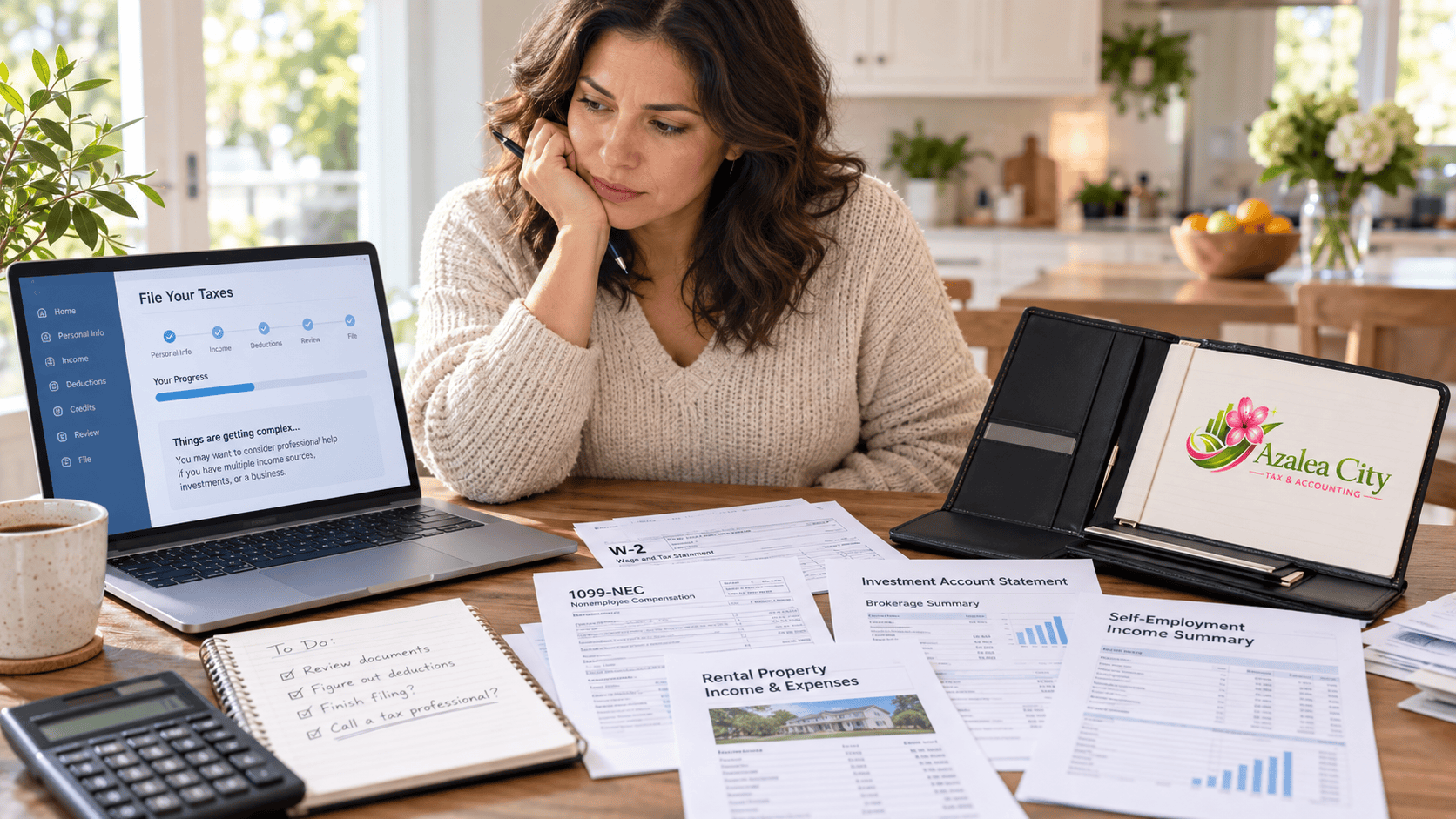
When Should You Use a Professional to File Your Taxes?
Filing your own return can make sense when your tax situation is straightforward. But business income, investments, rental property, major life changes, IRS problems, and more complicated deductions can quickly make professional tax preparation worth considering.
Filing taxes is an annual responsibility, but that does not mean every taxpayer needs the same level of help. Someone with one W-2, no major deductions, and a straightforward filing situation may feel perfectly comfortable preparing a return independently.
As income sources, investments, businesses, property, deductions, credits, or IRS issues become more complicated, however, professional tax preparation can provide more than convenience. It can help improve accuracy, identify issues before filing, coordinate complicated tax items, and make sure the return reflects the taxpayer's actual situation.
1. Your Financial Situation Has Become More Complex
One of the clearest signs that professional help may be worthwhile is when your return involves significantly more than straightforward wage income.
Multiple Income Sources
Multiple jobs, freelance work, rental properties, investments, royalties, partnership income, and other sources can create additional reporting requirements.
Self-Employment
Business owners and self-employed taxpayers may face deductions, estimated taxes, payroll issues, depreciation, entity questions, and self-employment tax.
Major Events
Marriage, divorce, children, buying or selling property, inheritances, and other major changes can affect filing status, deductions, credits, and overall tax liability.
Business owners in particular may benefit from integrating tax preparation with business consulting and proactive tax planning , rather than treating the tax return as an isolated annual event.
2. You Do Not Have the Time or Expertise to Keep Up With Tax Rules
Tax rules are detailed and frequently change. Even when tax software asks the right questions, the taxpayer still has to understand what information belongs in the return and whether the software's result makes sense.
A professional can be especially helpful when you are uncertain how to report an item, whether documentation is sufficient, or whether a transaction belongs in one tax category rather than another.
Software prepares forms. It does not replace judgment.
Tax software can be excellent for straightforward returns, but complex filing situations often require understanding the underlying transaction, tax law, documentation, and interaction between multiple tax provisions.
3. You Want to Identify Deductions, Credits, and Planning Opportunities
Tax preparation is not merely entering income onto a form. A qualified professional should also recognize when additional information may affect deductions, credits, or the treatment of a transaction.
If you want to better understand what may reduce your taxable income, review our guide to tax deductions and tax credits .
Investors
Investors may have capital gains and losses, dividend income, interest income, basis calculations, carryforwards, or other tax issues that require careful reporting.
Homeowners and Property Owners
Property ownership can introduce mortgage interest, property tax, rental income, depreciation, capital improvements, home-office questions, and gain or loss issues when property is sold.
Business Owners
Business owners may have significantly greater opportunities for proactive planning. This is why year-round tax planning is different from simply preparing a tax return after the year has already ended.
4. You Have Had Previous IRS or Tax Problems
If you have experienced audits, back taxes, penalties, missing returns, notices, or other IRS problems, professional help may be especially valuable.
A return connected to an unresolved IRS issue may require more than simply preparing forms. The professional may also need to review transcripts, prior filings, correspondence, payment history, or previous adjustments.
Azalea City's IRS problem-solving services are designed for taxpayers who need help understanding or resolving issues beyond ordinary return preparation.
Not every tax preparer has the same representation rights.
CPAs, Enrolled Agents, and attorneys generally have broader federal representation rights than many non-credentialed preparers. If IRS representation may become important, consider the preparer's credentials before hiring them.
5. You Have Special Tax Circumstances
Certain situations involve specialized tax rules that may justify professional assistance even when the taxpayer is otherwise comfortable preparing a return.
International Income and Foreign Assets
If you earn income while working or living outside the United States or hold certain foreign financial assets, additional reporting requirements may apply.
International tax reporting can involve income-tax rules, foreign-tax credits, treaty considerations, information returns, and significant penalties for certain reporting failures. This is an area where specialized knowledge may be particularly important.
Trusts and Estates
Trust and estate taxation can involve separate tax returns, beneficiary reporting, basis issues, distributions, fiduciary accounting, and other rules that differ from an ordinary individual Form 1040.
Large Transactions
Selling a business, selling investment or rental property, receiving an inheritance, exercising certain stock compensation, or completing other large transactions may create tax consequences that are difficult to address correctly without additional review.
6. You Want Confidence That the Return Was Prepared Correctly
For many taxpayers, one of the biggest benefits of hiring a professional is simply confidence in the process.
Taxes can create unnecessary stress when you are unsure whether income was reported correctly, whether a deduction is legitimate, whether a credit applies, or whether a return is likely to create an IRS problem later.
A professional does not eliminate the taxpayer's responsibility for the return, but a competent preparer can help organize the process, identify questions, explain the result, and reduce uncertainty.
When Is Filing Your Own Taxes Reasonable?
Professional preparation is not necessary for everyone. Filing independently may be perfectly reasonable when your situation is straightforward and you understand the return being filed.
Your income is straightforward.
You primarily receive W-2 wages and ordinary bank interest with few unusual transactions.
Your deductions are simple.
You take the standard deduction or otherwise have a filing situation you understand clearly.
You are comfortable reviewing the return.
You understand the information being reported and can recognize if the tax result appears inconsistent with your situation.
There are no unusual tax issues.
You do not have business income, complicated investment activity, rental property, foreign reporting, major transactions, or unresolved IRS problems.
How to Choose the Right Tax Professional
Deciding to hire a professional is only the first step. Tax preparers can have very different education, credentials, experience, representation rights, and areas of expertise.
The IRS provides guidance for choosing a qualified tax professional , including reviewing credentials, fees, availability, and the preparer's professional history.
Ask These Questions Before Hiring Someone
- What professional credentials do you hold?
- Do you have experience with returns like mine?
- Who will actually prepare and review my return?
- Are you available after tax season?
- How do you determine your preparation fee?
- Can you assist if the IRS later questions the return?
- How do I submit sensitive tax documents securely?
- Will you explain the completed return before it is filed?
For more detail on credentials, read our guide explaining what type of tax professional you may need .
The Decision Comes Down to Complexity, Risk, and Value
Not everyone needs a professional to file a tax return. But as your finances become more complicated, the value of knowledgeable tax preparation generally increases.
Multiple sources of income, business ownership, investment activity, property, major life changes, previous tax issues, specialized reporting, and uncertainty about deductions or credits are all reasonable signs that professional assistance deserves serious consideration.
The goal is not simply to produce a return. The goal is to file an accurate return, understand the result, remain compliant, and avoid missing important issues that could affect you later.
Professional Tax Preparation With Year-Round Support
Our team provides individual and business tax preparation, accounting, bookkeeping, tax planning, IRS problem solving, and business consulting. That allows us to look beyond the tax form itself and understand how the return fits into the larger financial picture.
Explore Professional Tax PreparationFrequently Asked Questions
At what point should I hire a tax professional instead of doing it myself?
Strong reasons to consider professional help include multiple income sources, business or self-employment income, rental property, substantial investment activity, large capital gains or losses, complicated deductions or credits, major life changes, previous IRS problems, or any situation where you are not confident the return is being prepared correctly.
Is it expensive to hire a tax professional—and is it worth it?
Fees vary according to the complexity of the return, the work required, and the professional's credentials. The better comparison is value rather than price alone. Professional preparation may be worthwhile when it helps prevent errors, identify legitimate tax benefits, resolve complicated reporting issues, or saves you substantial time.
If I started my taxes with software, can I switch to a professional before filing?
Yes. If you begin preparing a return yourself and then discover business income, rental activity, investment complications, an unfamiliar tax form, or another issue that exceeds your comfort level, you can stop and have a professional complete the return. Doing so before filing is usually much easier than correcting an incorrect return afterward.
Should business owners use professional tax preparation?
Business returns often involve more tax issues than ordinary wage-only individual returns, including expenses, depreciation, payroll, owner compensation, estimated taxes, entity reporting, and tax planning. Professional assistance can therefore become especially valuable for business owners.
What is the difference between a CPA, an Enrolled Agent, and another tax preparer?
Credentials, licensing, education, areas of practice, and IRS representation rights differ among tax professionals. CPAs are state-licensed accounting professionals, while Enrolled Agents are federally credentialed tax professionals. Other paid preparers may have different qualifications and representation rights. The appropriate professional depends on the work you need performed.
Can a tax professional help if I already have an IRS problem?
Yes, depending on the professional's qualifications and scope of practice. IRS notices, penalties, audits, back taxes, missing returns, payment issues, and prior-year discrepancies may require both tax preparation and IRS representation or problem-solving services.
Your Tax Return Should Be More Than a Guess and a Submit Button.
If your tax situation has become more complicated—or you simply want a professional review—Azalea City Tax & Accounting can help prepare the return, explain the result, and identify issues that deserve attention before filing.