
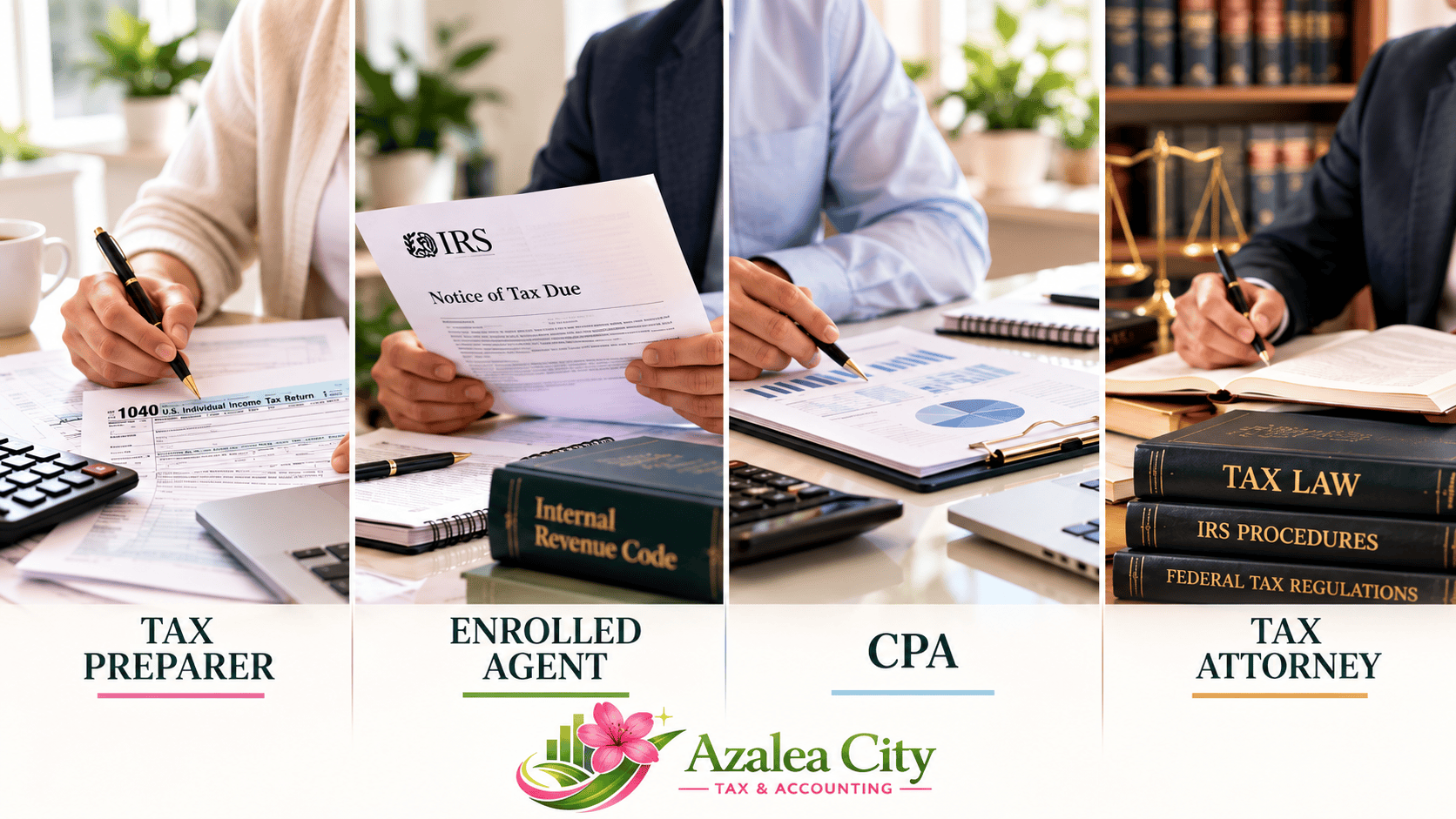
What Type of Tax Professional Do I Need?
Tax preparers, Enrolled Agents, CPAs, and tax attorneys can all play different roles. Understanding their credentials, specialties, and IRS representation rights can help you choose the right professional for your return, business, tax planning, or IRS problem.
Choosing a tax professional should involve more than simply searching for the closest person who prepares tax returns. Different professionals have different education, credentials, specialties, and authority to represent taxpayers before the IRS.
The most important question is not simply, "Who can prepare my return?" It is also, "Who has the training and authority to help me if my tax situation becomes more complicated?"
Anyone who prepares federal tax returns for compensation must generally have a valid Preparer Tax Identification Number, or PTIN. A PTIN, however, is not the same thing as a professional credential. The IRS recognizes important differences between preparers who hold professional credentials and those who do not.
In this article, we will take a practical look at four types of tax professionals you are likely to encounter: tax preparers, tax attorneys, Enrolled Agents, and Certified Public Accountants.
Tax Preparers
"Tax preparer" is a broad term. Some tax preparers are highly experienced professionals, while others may hold only a PTIN and have no professional tax credential. A person does not have to be an EA, CPA, or attorney to legally prepare federal tax returns for compensation.
That does not automatically mean an uncredentialed preparer is unqualified. Many preparers have years of practical experience. The difference is that a basic PTIN holder has not necessarily passed a standardized professional licensing examination or met the same continuing education requirements associated with an EA, CPA, or attorney credential.
Preparation Rights and Representation Rights Are Different
A PTIN generally permits a paid preparer to prepare federal tax returns, but it does not automatically give that preparer authority to represent taxpayers before the IRS. Representation rights depend on the preparer's credential or participation in certain IRS programs.
Return Preparation
A PTIN holder can prepare federal tax returns for compensation, subject to applicable IRS rules.
Credential Varies
Some preparers hold professional credentials and extensive training; others may have no credential beyond a PTIN.
Representation May Be Limited
Uncredentialed PTIN holders generally do not have the same IRS representation rights as EAs, CPAs, and attorneys.
Experience Still Matters
Credentials are important, but practical experience, specialty, availability, and the quality of the firm's work should also be considered.
For a very simple return, an experienced preparer may be perfectly capable of doing the work. If you own a business, have complicated investments, need substantial tax planning, receive an IRS notice, or want someone who can represent you before the IRS, a credentialed professional is often the better choice.
Tax Attorneys
A tax attorney is a lawyer whose practice includes federal, state, or local tax law. Attorneys are trained first and foremost in law, and their strongest role is often where a tax matter has a significant legal component.
A tax attorney may prepare tax returns, but return preparation is not necessarily the focus of the attorney's practice. Likewise, passing a state bar examination does not by itself mean that an attorney specializes in taxation. When hiring a tax attorney, experience in the specific type of tax matter you are facing is extremely important.
Choose Legal Tax Counsel When the Problem Is Primarily Legal
Tax attorneys can be especially valuable for tax litigation, criminal tax matters, privilege-sensitive advice, sophisticated transactions, estate planning, business reorganizations, and disputes where legal strategy is central to the case.
Compare Tax Professional OptionsAttorneys are one of the three major credentialed groups with unlimited representation rights before the IRS. That means a qualified attorney can represent taxpayers in IRS audits, appeals, collection matters, and other federal tax proceedings within the scope of IRS practice rules.
Enrolled Agents
Enrolled Agents, commonly called EAs, are federally credentialed tax professionals licensed by the IRS. The IRS describes enrolled agent status as the highest credential it awards.
Most EAs earn the credential by passing the three-part Special Enrollment Examination, which covers individual taxation, business taxation, and representation, practices, and procedures. Certain former IRS employees may qualify through their prior IRS experience instead.
The IRS requires Enrolled Agents to complete continuing education and adhere to federal ethical standards. You can read the IRS's official explanation on its Enrolled Agent Information page.
Federally Licensed
The EA credential is issued by the IRS rather than by a state licensing board.
Tax-Focused Testing
The Special Enrollment Examination is specifically focused on federal taxation and IRS representation.
Unlimited IRS Representation
EAs may represent taxpayers before the IRS in audits, appeals, collection matters, and other federal tax matters.
Individual and Business Tax
Many EAs specialize in tax preparation, tax planning, business taxation, and IRS problem solving.
An EA can be an excellent fit when your primary need is taxation: preparing individual or business returns, reducing future tax liability through planning, responding to IRS correspondence, handling an audit, or resolving a collection problem.
When Do I Need an Enrolled Agent?
If you are deciding whether an EA is the right professional for your situation, our detailed guide explains where the credential is especially useful and what an Enrolled Agent can do for taxpayers and businesses.
Read the Enrolled Agent GuideCertified Public Accountants
Certified Public Accountants, or CPAs, are state-licensed accounting professionals. Their education and examination cover a broad body of accounting knowledge that can include auditing, financial accounting, regulation, business concepts, and taxation.
CPAs can be extremely valuable when your needs extend beyond tax preparation into financial reporting, accounting systems, attest work, audits of financial statements, business advisory services, or complex accounting questions.
Many CPAs also build substantial tax practices and may have deep expertise in tax preparation, planning, and IRS representation. The credential itself is broader than taxation, so when selecting a CPA for tax work, you should still ask how much of the CPA's practice is devoted to tax.
CPAs Also Have Unlimited IRS Representation Rights
CPAs, like Enrolled Agents and attorneys, are recognized by the IRS as having unlimited representation rights. Their state license governs the CPA credential, but their federal IRS representation rights are not limited to representing taxpayers only within that state.
NerdWallet's guide to finding and evaluating a CPA or tax accountant also recommends looking beyond proximity by verifying credentials, considering experience, and making sure the professional's services match your actual tax and accounting needs.
When Do I Need a CPA?
A CPA may be especially helpful when your situation combines tax issues with financial accounting, reporting, business advisory work, or other accounting-intensive needs.
Read the CPA GuideEA vs. CPA vs. Tax Attorney vs. Tax Preparer
There is no single credential that is automatically "best" for every taxpayer. The right professional depends on what you actually need done.
| Professional | Best Known For | IRS Representation Rights |
|---|---|---|
| PTIN Tax Preparer | Preparing tax returns; experience and training vary considerably by preparer. | Generally no unlimited representation rights. Rights may be limited depending on credential or IRS program participation. |
| Enrolled Agent | Federal taxation, individual and business returns, tax planning, IRS audits, appeals, and collections. | Unlimited representation rights before the IRS. |
| Certified Public Accountant | Accounting, financial reporting, audit and attest work, business advisory services, plus tax when it is part of the CPA's practice. | Unlimited representation rights before the IRS. |
| Tax Attorney | Legal analysis, tax litigation, complex transactions, privilege-sensitive matters, and tax controversies with a significant legal component. | Unlimited representation rights before the IRS. |
The practical takeaway is that credentials tell you what authority and baseline professional standards a person has, but specialty tells you whether that person is the right fit for your specific problem.
So, Which Tax Professional Do You Need?
For most taxpayers, the choice comes down to the complexity of the return and the type of help needed beyond filing it.
Simple Tax Return
An experienced tax preparer may be sufficient for a straightforward return, but you should still verify that the preparer has a valid PTIN, signs the return, and will be available after filing season.
Tax Planning, Business Taxes, or IRS Problems
An Enrolled Agent or tax-focused CPA is often a strong choice because both can prepare returns and provide unlimited representation before the IRS.
Accounting, Financial Statements, or Attest Work
A CPA may be the better fit when the engagement requires substantial accounting expertise or services that are specifically associated with the CPA profession.
Tax Litigation or Complex Legal Issues
A tax attorney may be the right professional when the primary issue is legal rather than accounting or return preparation.
Many taxpayers and business owners benefit from a firm where professionals with different credentials work together. A business might need bookkeeping and accounting support, an EA or CPA for tax planning and return preparation, and an attorney only when a legal issue requires one.
How to Choose a Tax Professional
Credentials matter, but they should not be the only factor in your decision. Before turning over sensitive financial information, ask enough questions to understand who will actually perform the work and what happens if a problem comes up later.
Verify the Credential
Confirm that the professional's EA enrollment, CPA license, attorney license, or other claimed credential is active and in good standing.
Ask About Tax Experience
Find out how much of the professional's practice involves the type of return, industry, or IRS problem you have.
Confirm Year-Round Availability
Tax questions do not stop on April 15. Make sure you know whether the preparer will be available if you receive a notice months later.
Look for Planning, Not Just Filing
If you own a business or have a complicated financial life, a professional who provides proactive tax planning may create far more value than someone who only records what already happened.
Be cautious of anyone who promises a specific refund before reviewing your records, refuses to sign the return, asks you to sign a blank return, or bases the fee on a percentage of the refund. Your tax return remains your legal responsibility even when someone else prepares it.
Tax Preparation and Tax Planning at Azalea City Tax & Accounting
At Azalea City Tax & Accounting, our work goes beyond entering numbers into tax software. We work with individuals and business owners on tax preparation, tax planning, accounting, business consulting, and IRS problem solving.
Having both Enrolled Agent and CPA expertise available means clients can receive tax-focused guidance while also having access to broader accounting knowledge when the situation calls for it.
Not Sure Which Professional You Need? Start With the Problem.
Tell us what you are trying to accomplish—filing a return, reducing future taxes, fixing an IRS issue, improving business accounting, or planning for growth—and we can help determine the right type of professional and service for the job.
Request a ConsultationFrequently Asked Questions About Tax Professionals
What is the difference between a tax preparer and a tax professional?
"Tax preparer" broadly describes someone who prepares tax returns. A credentialed tax professional may also be an Enrolled Agent, CPA, or attorney and may have additional education, licensing requirements, continuing education obligations, and IRS representation rights.
Who can represent me before the IRS?
Enrolled Agents, CPAs, and attorneys have unlimited representation rights before the IRS. Certain other preparers may have limited representation rights depending on their qualifications and participation in IRS programs.
Is an Enrolled Agent better than a CPA for taxes?
Not automatically. EAs are federally credentialed tax specialists whose qualifying examination is specifically focused on taxation and IRS representation. CPAs have a broader accounting credential, and many CPAs also specialize heavily in tax. The better choice depends on the professional's actual experience and the services you need.
Do CPAs have unlimited representation rights before the IRS?
Yes. CPAs, Enrolled Agents, and attorneys are the three principal credentialed groups the IRS recognizes as having unlimited representation rights before the agency.
When should I hire a tax attorney?
A tax attorney may be appropriate when the matter involves litigation, a significant legal dispute, criminal tax exposure, sophisticated transactions, legal privilege concerns, estate planning, or another issue where legal analysis is central.
Does every paid tax preparer need a CPA or EA license?
No. A person can generally prepare federal tax returns for compensation with a valid PTIN without being a CPA or EA. However, the preparer's professional credential affects training requirements and representation rights, so taxpayers should understand exactly who they are hiring.
Should a business owner use a CPA or an Enrolled Agent?
Either may be a strong choice. An EA can be particularly well suited to federal tax preparation, planning, and IRS representation, while a CPA may be especially useful when the business also needs deeper accounting, financial reporting, or attest services. Many businesses benefit from access to both skill sets.
Choose a Tax Professional Based on What You Actually Need.
Whether you need tax preparation, proactive tax planning, business accounting, or help dealing with the IRS, Azalea City Tax & Accounting can help you determine the right approach and put the right expertise to work.