
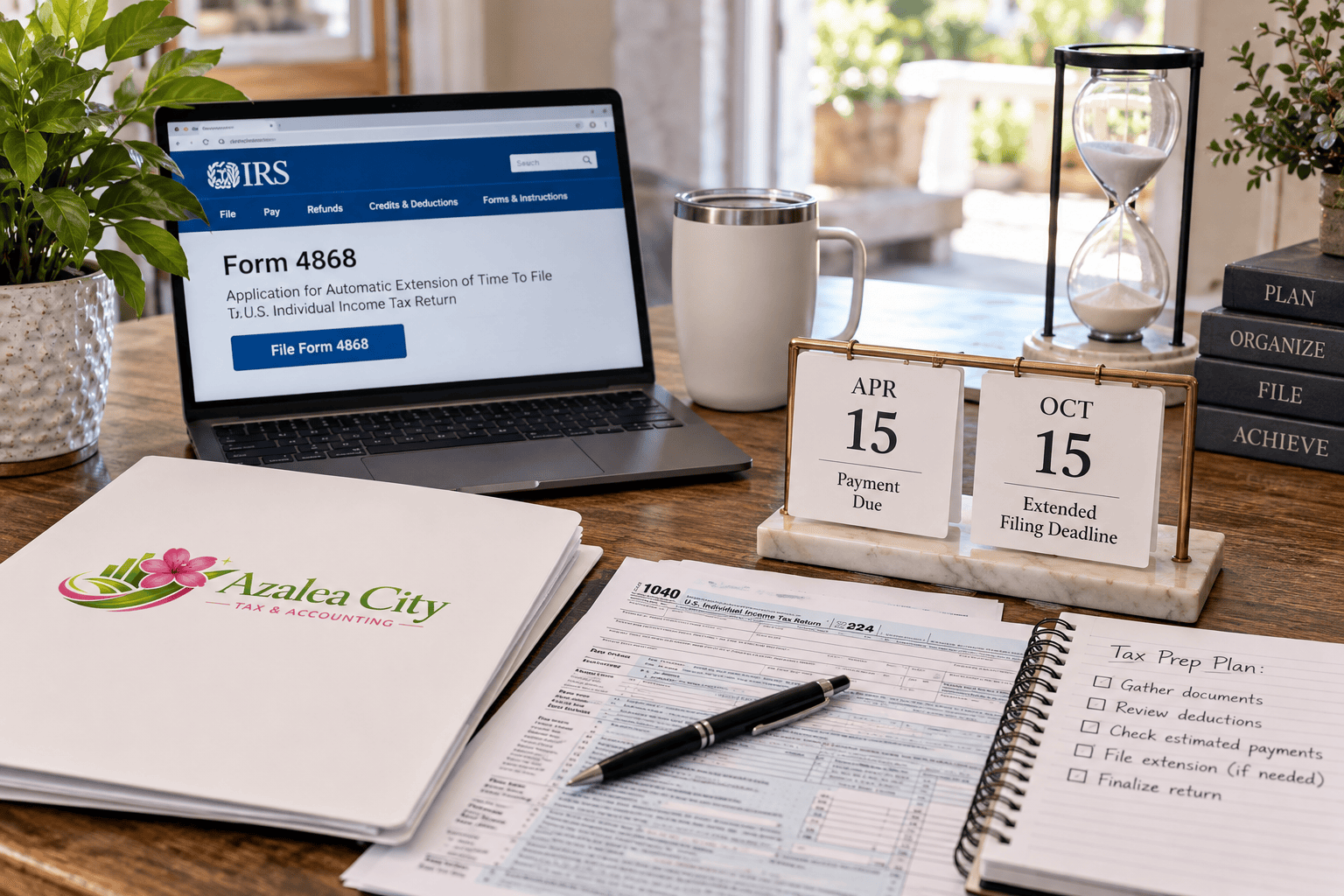
How Do Tax Extensions Work? What Taxpayers Need to Know
A tax extension can give you more time to prepare and file your return—but it does not normally give you more time to pay the tax you owe. Understanding that distinction can help you avoid unnecessary penalties, interest, and last-minute filing mistakes.
Tax season does not always cooperate with real life. Records may be missing, investment forms may arrive late, bookkeeping may still need to be completed, or a business return may depend on information that simply is not ready by the original filing deadline.
That is exactly why federal tax extensions exist. A properly filed extension can provide additional time to prepare an accurate return rather than rushing simply to meet a deadline.
But there is one rule every taxpayer should understand: an extension of time to file is generally not an extension of time to pay.
What Is a Tax Extension?
A tax extension is a request to the Internal Revenue Service for additional time to file a federal tax return.
For most individual taxpayers, a timely federal extension provides up to six additional months to file the return. A calendar-year individual whose return would ordinarily be due in April generally receives until October 15 to file.
Extension to file ≠ extension to pay.
The extension generally moves the filing deadline—not the date your tax is due. If you expect to owe, you should estimate the balance and make an appropriate payment by the original payment deadline.
The IRS maintains a current guide to requesting an extension to file an individual tax return .
How Do Individuals Request a Tax Extension?
Individual taxpayers generally request an automatic federal extension using Form 4868, Application for Automatic Extension of Time to File U.S. Individual Income Tax Return .
There are several ways to obtain the extension.
File Electronically
An extension can generally be submitted electronically through participating tax software, a tax professional, or qualifying IRS electronic filing options.
Make an Extension Payment
Individuals may also obtain an extension through certain electronic IRS payment methods by identifying the payment as an extension payment.
Mail Form 4868
Taxpayers who cannot or do not want to file electronically can generally submit Form 4868 by mail according to the form instructions.
The IRS also offers information about requesting an extension electronically .
How Do Business Tax Extensions Work?
Businesses do not necessarily use the same extension form as individual taxpayers.
Many corporations, S corporations, partnerships, and other business entities request an automatic extension using Form 7004, Application for Automatic Extension of Time to File Certain Business Income Tax, Information, and Other Returns .
Form 7004 generally must be filed by the original due date of the applicable business return. The form covers numerous return types, so business owners should confirm that the return being extended is actually eligible and use the correct tax-form code.
A business extension can affect the owner's personal return.
Partnerships and S corporations issue Schedule K-1s to their owners. If the entity return is extended, the owners may need to extend their individual returns as well if they are still waiting on final K-1 information.
Business owners who routinely find themselves extending because books are not ready may also want to evaluate their bookkeeping and payroll process before the next filing season.
Common Federal Extension Deadlines
Exact deadlines depend on the return, tax year, entity's fiscal year, weekends, legal holidays, and any special IRS relief. The following are the general rules for common calendar-year filers.
| Return Type | General Calendar-Year Timeline |
|---|---|
| Individual — Form 1040 | Generally due in April. A timely extension normally provides until October 15 to file. |
| Partnership — Form 1065 | Generally due on the 15th day of the third month after the tax year ends. A calendar-year partnership is normally due in March, with an extended deadline generally six months later. |
| S Corporation — Form 1120-S | Generally due on the 15th day of the third month after the tax year ends. A calendar-year S corporation is normally due in March, with an extended deadline generally six months later. |
| C Corporation — Form 1120 | The due date depends on the corporation's tax year and applicable federal filing rules. Form 7004 is generally used when an extension is needed. |
| Tax-Exempt Organization — Form 990 | Generally due on the 15th day of the fifth month after the organization's accounting period ends. Many exempt organizations can obtain a six-month extension using Form 8868. |
Because return dates can shift when the normal deadline falls on a weekend or legal holiday, taxpayers should confirm the deadline for the particular filing year instead of assuming that the numerical date is identical every year.
Do I Still Have to Pay My Taxes by the Original Deadline?
Generally, yes. This is the most important concept in the entire extension process.
A federal income-tax extension gives additional time to file the return. It does not ordinarily postpone the date the underlying income tax is due.
Estimate your total tax liability.
Use the information available to make a reasonable estimate of your income, deductions, credits, payments, and total expected federal tax.
Subtract payments already made.
Consider withholding, estimated tax payments, prior payments, and other amounts already credited toward the year's tax.
Pay the expected remaining balance.
Paying as much of the expected balance as possible by the original payment deadline can reduce potential interest and late-payment penalties.
File the completed return by the extended deadline.
Once the remaining records are available, complete the actual return and reconcile the final tax liability with the amount previously estimated and paid.
The IRS specifically emphasizes that an extension to file is not an extension of time to pay the tax owed .
What If You Cannot Afford to Pay the Full Balance?
Not being able to pay the full tax balance is generally not a good reason to avoid filing the return or requesting an extension.
If you cannot pay everything by the original deadline, paying what you reasonably can may reduce the amount on which penalties and interest continue to accrue.
Depending on the circumstances, taxpayers may also have access to IRS payment options after the return is filed.
File even when you cannot pay everything.
A taxpayer who cannot pay should generally distinguish the filing problem from the payment problem. Filing or extending timely can help avoid creating a separate late-filing issue on top of the unpaid balance.
If an unpaid tax balance has already developed into notices, penalties, collections, or another unresolved IRS matter, our IRS problem-solving services may be more appropriate than ordinary return preparation alone.
What Happens If You File or Pay Late?
Filing late and paying late are separate issues under federal tax rules. Depending on the circumstances, a taxpayer can face different penalties for each.
Failure-to-File Penalty
A taxpayer who misses the required filing deadline without a valid extension may be subject to a failure-to-file penalty when tax remains unpaid.
Failure-to-Pay Penalty
Unpaid tax after the payment deadline may be subject to a separate failure-to-pay penalty, even when the return itself was properly extended.
Interest
Interest generally accrues on unpaid federal tax from the payment due date until the balance is paid.
The IRS publishes current information about federal tax penalties and interest charged on unpaid tax .
This is one reason filing a valid extension can matter. It may help prevent a taxpayer who genuinely needs additional preparation time from also creating an unnecessary late-filing problem.
Special Considerations for Different Types of Filers
Individuals
Individuals generally use Form 4868. If a refund is expected, an extension gives more time to file, but the IRS cannot issue the refund until the actual income-tax return is filed and processed.
Partnerships and S Corporations
Partnerships and S corporations are generally pass-through entities. Their returns produce Schedule K-1 information that partners and shareholders may need before completing their individual tax returns.
That makes coordination particularly important. If an entity return cannot be completed by its original deadline, the owners should determine whether their individual returns also need extensions.
C Corporations
C corporations generally file Form 1120 and may request an extension using Form 7004 when eligible. An extension of the corporation's filing deadline generally does not postpone the corporation's obligation to pay tax that is due.
Tax-Exempt Organizations
Many exempt organizations use Form 8868 to obtain an extension for qualifying exempt-organization returns .
Organizations should also remember that repeated failures to file required Form 990-series returns can create problems beyond an ordinary late-filing penalty, including potential consequences for tax-exempt status.
Benefits of Filing a Tax Extension
Extensions sometimes get treated as though they indicate a tax problem. In reality, filing an extension can be a perfectly normal part of responsible tax preparation.
Avoid a Rushed Return
Additional time can allow taxpayers to gather missing documentation and avoid making unnecessary mistakes simply to meet the original deadline.
Protect the Filing Deadline
A timely extension can preserve additional time to file and help avoid certain late-filing consequences when the return cannot reasonably be completed on time.
Allow Professional Review
Complex returns may benefit from additional bookkeeping, accounting review, document gathering, and coordination before the final return is submitted.
The extra time can also allow you to work with a professional tax preparer rather than filing an incomplete or inaccurate return because the original deadline is approaching.
What a Tax Extension Does Not Do
Understanding what an extension does not accomplish is just as important as understanding what it does.
- It does not normally give you six extra months to pay income tax that was already due.
- It does not eliminate interest on an unpaid balance.
- It does not automatically eliminate late-payment penalties.
- It does not replace the requirement to file the actual return.
- It does not automatically extend every state tax return.
- It does not fix inaccurate bookkeeping or missing financial records.
- It does not mean the taxpayer is under audit or has done anything wrong.
An extension is a filing tool—not a tax strategy by itself.
The goal should be to use the additional time productively: finish the books, obtain missing documents, calculate the return correctly, and file before the extended deadline.
Does a Federal Extension Automatically Extend Your State Return?
Not necessarily. State extension rules vary.
Some states recognize a valid federal extension, while others have separate extension forms, payment requirements, or filing procedures. A taxpayer who files in more than one state may have different requirements for each jurisdiction.
This is particularly important for business owners, remote workers, rental-property owners, and taxpayers who moved during the year. Extending the federal return should not be treated as proof that every state filing obligation has also been extended.
When Does Filing an Extension Make Sense?
An extension may be appropriate when filing an accurate return by the original deadline is unrealistic.
- You are still waiting for corrected or late tax documents.
- Your business bookkeeping is not complete.
- You are waiting for one or more Schedule K-1s.
- You experienced a major life or business event during the year.
- Your return includes unusually complicated transactions.
- You recently changed tax professionals.
- Your preparer needs more time to properly review the return.
- You need additional time to reconstruct missing records.
If your return has become complicated enough that you are unsure whether to prepare it yourself, our guide explaining when you should use a professional to file your taxes may also be helpful.
What Should You Do After Filing an Extension?
An extension should not become an excuse to forget about the return until October.
Finish gathering documents.
Obtain missing W-2s, 1099s, K-1s, brokerage statements, business records, receipts, and supporting documents.
Complete bookkeeping and reconciliations.
Business owners should make sure income, expenses, loans, payroll, credit cards, and bank accounts are properly recorded and reconciled.
Compare the final balance to your extension payment.
Once the actual return is prepared, determine whether additional tax is due or whether the extension payment created an overpayment.
File before the extended deadline.
There is no advantage to waiting until the final day if the return is already complete and ready to file.
Extensions Can Be Useful When They Are Used Correctly
A tax extension is not a loophole and it is not a sign that something has gone wrong. It is simply a mechanism that gives eligible taxpayers additional time to file an accurate return.
The key is understanding the distinction between the filing deadline and the payment deadline. If tax is expected to be due, estimate the amount carefully and pay as much as appropriate by the original deadline.
Then use the extension period for its intended purpose: completing the records, resolving unanswered questions, reviewing the return, and filing accurately before the extended deadline.
Already Extended—or Need Help Deciding Whether You Should?
Our team can help prepare individual and business extensions, estimate tax due, complete extended tax returns, review bookkeeping, and coordinate the filing process so an extension becomes useful preparation time instead of another missed deadline.
Explore Professional Tax PreparationFrequently Asked Questions
Does filing a tax extension give me more time to pay?
Generally, no. A federal extension normally gives you additional time to file the return, but income tax owed is generally still due by the original payment deadline. Paying after that date may result in interest and potentially late-payment penalties.
How long does a tax extension give an individual?
A timely extension for a calendar-year individual generally provides up to six additional months to file, moving an ordinary April federal filing deadline to October 15. Special rules can apply to taxpayers abroad, disaster-area taxpayers, military personnel, and other situations.
Will filing an extension increase my chances of being audited?
Filing a legitimate extension is a normal tax procedure. An extension simply gives additional time to file the return and should not be treated as an admission that something is wrong with the return.
What form do individuals use for a federal extension?
Individuals generally use Form 4868, Application for Automatic Extension of Time to File U.S. Individual Income Tax Return. Certain electronic extension-payment methods can also secure an extension without separately mailing Form 4868.
What form do businesses use for a tax extension?
Many partnerships, corporations, S corporations, and other entities use Form 7004. However, the correct form depends on the type of return being extended, so the entity should confirm that Form 7004 applies to its particular filing obligation.
What if I am expecting a refund?
If no tax is owed, the payment issue may not be a concern, but the IRS cannot issue your refund until the actual income-tax return has been filed and processed. Filing an extension therefore delays the filing requirement—not the need to eventually submit the completed return.
Can I file my return before the extended deadline?
Yes. An extension establishes the latest permitted filing date under the extension; it does not require you to wait until that date. If your return is complete and accurate earlier, you can file it earlier.
Does a federal extension automatically extend my state return?
Not always. State rules vary. Some states recognize a federal extension while others require additional forms, payments, or procedures. Taxpayers should verify the requirements for every state in which they have a filing obligation.
Need More Time? Make Sure the Extension Is Done Correctly.
Whether you need an extension filed, have already extended and still need the return completed, or are unsure how much tax should have been paid with the extension, Azalea City Tax & Accounting can help.