
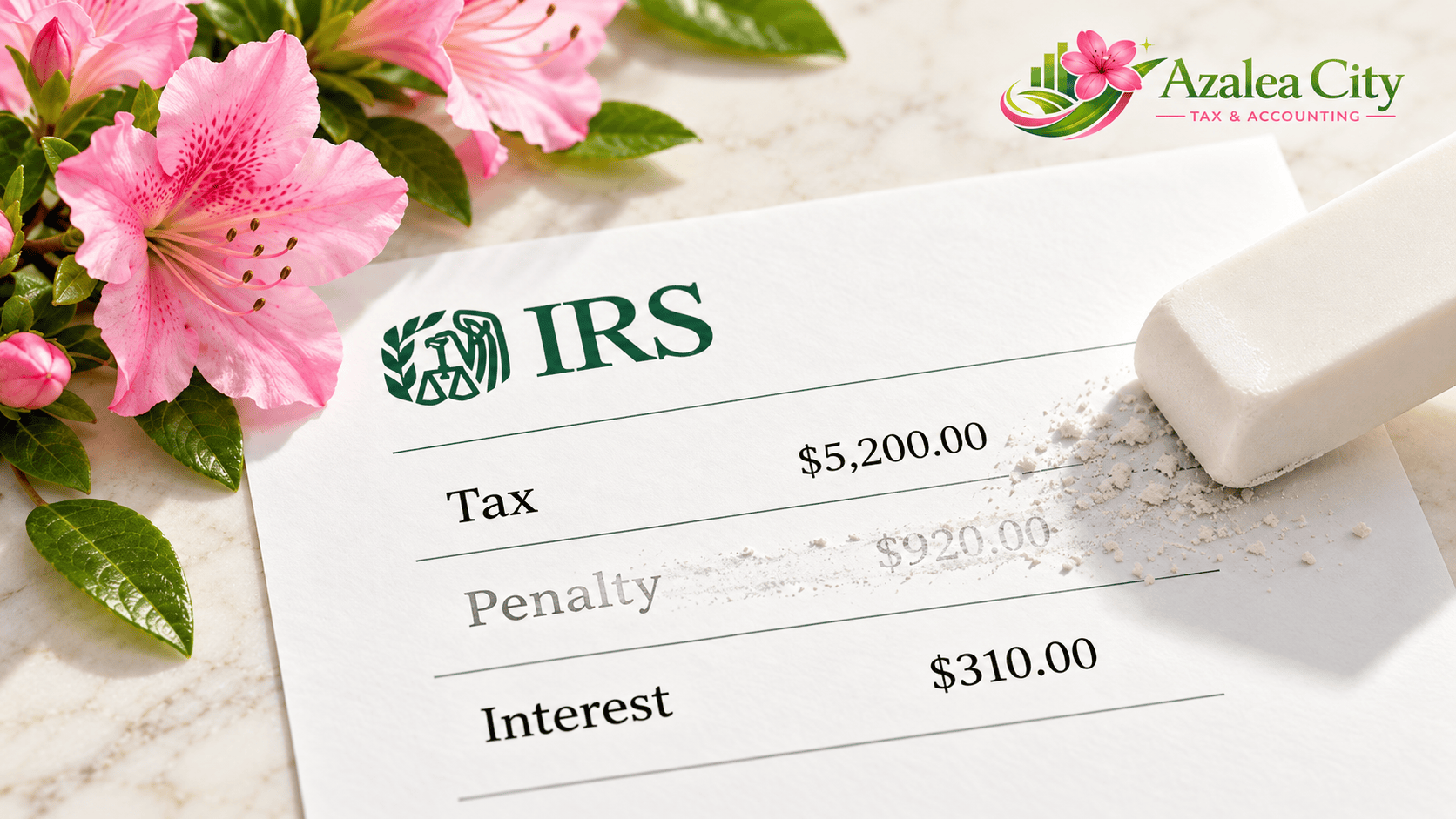
IRS First-Time Penalty Abatement: When Can the IRS Forgive Penalties?
If you have a strong history of filing and paying on time, certain IRS penalties may be eligible for removal. First-Time Abatement has long provided administrative penalty relief, and the IRS is now transitioning eligible taxpayers toward a new automatic relief process.
IRS penalties can turn a manageable tax balance into a much larger problem. A late return, late payment, or missed payroll tax deposit may create penalties on top of the underlying tax and interest. What many taxpayers do not realize is that the IRS has administrative procedures that may allow certain penalties to be removed when the taxpayer has an otherwise clean compliance history.
One of the best-known forms of relief is First-Time Abatement, often called FTA. It is not a settlement of the tax itself, and it is not a blanket forgiveness program. Instead, it is an administrative waiver that may remove qualifying penalties when the taxpayer meets the IRS's compliance requirements.
The phrase "penalty forgiveness" is commonly used by taxpayers, but the IRS generally refers to the process as penalty relief or penalty abatement. The distinction matters because different types of penalties qualify under different rules, and the facts of the case determine which relief method should be requested.
The IRS maintains an overview of available relief on its official Penalty Relief page. Depending on the situation, relief may be available through an administrative waiver such as First-Time Abatement, reasonable cause, a statutory exception, or another IRS procedure.
What Is IRS First-Time Penalty Abatement?
First-Time Abatement is an IRS administrative relief policy designed for taxpayers who generally have a good filing and payment history but experience a one-time compliance problem. When the requirements are satisfied, the IRS may remove certain penalties without requiring the taxpayer to prove that an extraordinary event caused the late filing, late payment, or late deposit.
That makes FTA different from reasonable cause relief. Reasonable cause focuses on why the taxpayer failed to comply. First-Time Abatement focuses primarily on the taxpayer's prior compliance history and whether the current filing and payment requirements have been addressed.
Failure to File
A qualifying late-filed return may generate a failure-to-file penalty. First-Time Abatement has traditionally been available for eligible taxpayers when the IRS's compliance-history rules are met.
Failure to Pay
Taxpayers who filed but did not pay the full balance by the required date may be assessed a failure-to-pay penalty. Certain taxpayers may qualify to have that penalty removed.
Failure to Deposit
Businesses may face penalties for late or insufficient federal tax deposits. First-Time Abatement has also applied to qualifying failure-to-deposit penalties in appropriate circumstances.
Administrative Relief
FTA does not require the same factual showing as reasonable cause. Eligibility is primarily driven by prior compliance and the status of current filing and payment obligations.
Important 2026 Update: First-Time Abatement Is Changing
FTA Is Being Phased Into Automatic Penalty Relief
In July 2026, the IRS announced a new Automatic Exemption from Penalty program, commonly referred to as AEP. The IRS stated that AEP will replace the long-standing First-Time Abate process for eligible returns with original due dates on or after January 1, 2027, while a transition period continues during 2026.
Under the new process, qualifying taxpayers with a history of timely filing and payment may receive relief automatically for certain failure-to-file, failure-to-pay, and failure-to-deposit penalties. For eligible original returns beginning with tax year 2025 and eligible 2026 quarterly returns, the IRS has announced that some taxpayers may receive the exemption without making a separate request.
During the transition, however, some taxpayers may still receive a penalty notice even though they appear to satisfy the historical First-Time Abatement criteria. The IRS has stated that taxpayers who believe they qualify may still contact the agency to request First-Time Abatement during the transition period.
The practical lesson is simple: do not assume a penalty notice is automatically correct or automatically final. A notice should be reviewed to determine the tax period involved, the type of penalty assessed, whether an automatic exemption should have applied, and whether another form of penalty relief is available.
Who May Qualify for First-Time Abatement?
Eligibility depends on the specific penalty and tax period, but the central concept is a history of compliance. Traditionally, the IRS reviews the prior three-year period for the same type of return to determine whether the taxpayer has filed required returns and avoided significant penalties.
Required Returns Should Be Filed
The taxpayer generally must have filed all currently required returns or filed a valid extension for a return that is not yet due.
Prior Compliance History Matters
The IRS generally looks for a clean compliance history during the preceding three years. Prior penalty assessments can affect eligibility depending on the type of penalty and whether earlier relief was already granted.
The Current Tax Must Be Addressed
The taxpayer should have paid the tax due or made acceptable arrangements to pay it, such as an approved installment agreement when appropriate.
The Penalty Must Be Eligible
First-Time Abatement is not a universal waiver. The penalty must fall within a category eligible for administrative relief under the applicable IRS rules.
A taxpayer who has never been required to file a particular return may also receive favorable treatment because there may be no prior filing history against which to measure compliance. Business returns can involve additional rules, especially where payroll tax deposits are concerned.
What Does Penalty Abatement Actually Remove?
Penalty abatement does not erase the underlying tax. If the IRS correctly determined that tax is owed, the tax generally remains due even when a penalty is removed. Interest on the unpaid tax can also remain due.
| Amount on the Account | What Penalty Relief May Do |
|---|---|
| Underlying tax | Generally remains due unless the tax assessment itself is changed or corrected. |
| Eligible penalties | May be reduced or removed when the taxpayer qualifies for the applicable relief provision. |
| Interest charged on an abated penalty | The IRS generally adjusts related interest when the underlying penalty is reduced or removed. |
| Interest on unpaid tax | Usually continues until the tax balance is paid, even if a penalty is abated. |
| Other nonqualifying penalties | Remain unless a separate relief rule, reasonable-cause argument, statutory exception, or correction applies. |
This distinction is especially important when a notice shows one combined balance. A taxpayer may see tax, penalties, and interest on the same notice and assume the entire amount is negotiable. In reality, each component must be analyzed separately.
How Do You Request IRS Penalty Relief?
The correct procedure depends on the notice, tax period, penalty, and relief being requested. The IRS instructs taxpayers to begin by following the directions on the penalty notice. Some requests can be handled by telephone, while others may require a written submission.
Review the Entire IRS Notice
Identify the notice number, tax form, tax year or quarter, penalty type, amount assessed, response deadline, and IRS contact information. If you need help interpreting the notice, read our guide on what to do if you get an IRS letter.
Verify Filing and Payment Compliance
Confirm that required returns are filed and determine whether the tax has been paid or is being handled through an acceptable payment arrangement.
Determine the Best Relief Method
A taxpayer may qualify for First-Time Abatement, the new automatic exemption, reasonable cause, a statutory exception, or another form of relief. Choosing the correct basis matters.
Contact the IRS or Submit a Written Request
Some requests may be resolved by calling the number on the IRS notice. When telephone approval is not available, a written request or Form 843 may be appropriate depending on the penalty and circumstances.
Keep Documentation of the Result
Save copies of letters, transcripts, account adjustments, confirmation notices, and any written decision showing whether the penalty was removed or the request was denied.
Does Filing an Extension Prevent IRS Penalties?
A valid extension generally extends the time to file an income tax return, but it usually does not extend the time to pay the tax. This is one of the most common sources of confusion when taxpayers later receive a penalty notice.
For example, a taxpayer may properly extend a return and therefore avoid a failure-to-file penalty through the extended deadline, while still owing a failure-to-pay penalty because the tax was not paid by the original payment due date. The exact result depends on the return, payment history, and applicable rules.
For a broader explanation, see our guide on how tax extensions work.
First-Time Abatement vs. Reasonable Cause
These two forms of penalty relief are often confused, but they are based on different theories. First-Time Abatement is primarily an administrative waiver based on compliance history. Reasonable cause is a facts-and-circumstances argument explaining why the taxpayer could not comply despite exercising ordinary business care and prudence.
| First-Time Abatement | Reasonable Cause |
|---|---|
| Focuses heavily on prior compliance history. | Focuses on the facts that caused the late filing, payment, or deposit. |
| May not require proof of an extraordinary event. | Usually requires a detailed explanation and supporting evidence. |
| Traditionally limited to certain penalty types. | May apply to a broader range of penalties when the governing rules permit reasonable-cause relief. |
| Best suited for an otherwise compliant taxpayer with an isolated issue. | Best suited when specific circumstances prevented timely compliance. |
A taxpayer who does not qualify for FTA should not automatically assume that no relief is available. Medical emergencies, natural disasters, destruction of records, serious disruptions, reliance issues, and other circumstances may support a reasonable-cause request depending on the facts and the penalty involved.
Common Mistakes When Requesting Penalty Forgiveness
When Professional Help Can Make a Difference
Penalty relief can look simple on the surface, but the IRS account must be reviewed carefully. The correct strategy may depend on whether the penalty was properly calculated, whether the return was actually late, whether a payment was misapplied, whether an extension was valid, whether prior penalties affect FTA eligibility, and whether the taxpayer has a stronger reasonable-cause argument.
Businesses may have additional complications involving payroll deposits, quarterly filings, multiple tax periods, responsible-party issues, or a history of prior assessments. In those situations, analyzing the transcript and penalty codes before making a request can prevent an avoidable denial.
Have an IRS Penalty Notice Reviewed Before You Simply Pay It
We can review the notice, identify the penalty and tax period involved, evaluate potential First-Time Abatement or other penalty-relief options, and help determine the most appropriate response based on the account history and current IRS procedures.
Request a Penalty ReviewFrequently Asked Questions About IRS Penalty Abatement
Can the IRS really forgive penalties?
Yes. The IRS has several penalty-relief procedures. Depending on the penalty and facts, relief may be available through First-Time Abatement, the newer Automatic Exemption from Penalty process, reasonable cause, a statutory exception, or another applicable rule.
Does First-Time Abatement erase the tax I owe?
No. First-Time Abatement generally addresses eligible penalties. The underlying tax normally remains due, and interest on unpaid tax may continue until the balance is paid.
How many years does the IRS look back for First-Time Abatement?
The traditional First-Time Abatement analysis generally considers the three prior years for the relevant return type. The newer AEP program also uses a three-year timely filing and payment history for many eligible annual returns, or 12 consecutive quarters for qualifying quarterly returns.
Can I get First-Time Abatement more than once?
Potentially, but not simply year after year. Because prior penalty and compliance history affects eligibility, a taxpayer must again satisfy the applicable clean-history requirements before administrative first-time relief would be available for a later period.
Can I request abatement after I already paid the penalty?
In some situations, yes. A paid penalty may still be eligible for an abatement or refund claim, subject to the applicable procedures and time limits. The specific tax period and payment dates should be reviewed before filing a claim.
What if the IRS denies my penalty-relief request?
A denial does not always end the matter. Depending on the penalty and procedural posture, appeal rights or another relief basis may be available. The denial notice should be reviewed for deadlines and instructions.
Does an installment agreement prevent penalty abatement?
Not necessarily. For traditional FTA eligibility, taxpayers generally need to have paid the tax or made acceptable arrangements to pay it. A valid installment agreement may satisfy the payment-compliance requirement in appropriate circumstances.
Before You Pay an IRS Penalty, Find Out Whether It Can Be Removed.
Azalea City Tax & Accounting can review your IRS notice, compliance history, and account status to determine whether First-Time Abatement, automatic penalty relief, reasonable cause, or another penalty-relief strategy may apply.