CPA vs. EA: What’s the Difference?
Certified Public Accountants and Enrolled Agents are both highly credentialed professionals, but the licenses were designed with different areas of emphasis. Understanding those differences can help you choose the right professional for tax preparation, tax planning, IRS representation, accounting and business advisory.
Most people recognize the letters CPA. The Certified Public Accountant credential has been part of the accounting profession for generations. But fewer taxpayers are familiar with another important credential: EA — Enrolled Agent.
Both CPAs and EAs can be excellent tax professionals. The primary difference is not that one credential is automatically “better” than the other. They come from different licensing systems and traditionally emphasize different areas of professional practice.
A Tale of Two Professional Credentials
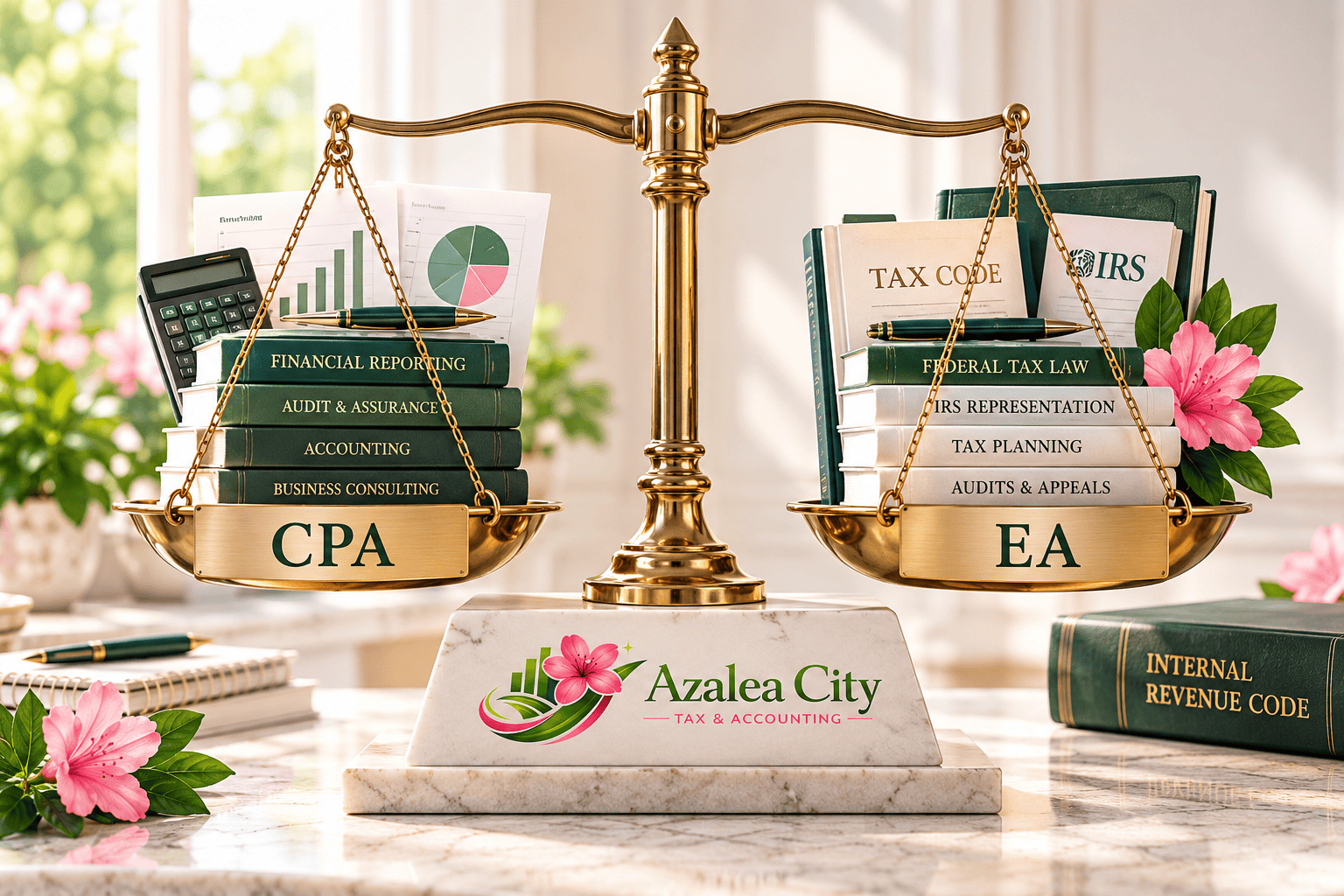
An Enrolled Agent is a federally credentialed tax professional authorized to practice before the Internal Revenue Service. A Certified Public Accountant is licensed through a state board of accountancy and is trained across a broader range of accounting, auditing, financial reporting and tax subjects.
Enrolled Agent
A federal tax credential focused heavily on taxation, tax compliance and representation before the IRS.
- Federally credentialed through the IRS
- Unlimited practice rights before the IRS
- Strong emphasis on individual and business taxation
- May represent taxpayers in IRS audits, collections and appeals
Certified Public Accountant
A state-issued professional accounting license with training extending across accounting, auditing, financial reporting, tax and related disciplines.
- Licensed through a state board of accountancy
- Broad accounting and financial-reporting education
- May perform services requiring CPA licensure, subject to applicable state rules
- Can also provide tax preparation and IRS representation
What Is an Enrolled Agent?
An Enrolled Agent is a tax professional who has earned the privilege of representing taxpayers before the Internal Revenue Service.
The IRS describes enrolled agent status as the highest credential it awards. An EA can earn the credential by passing the IRS Special Enrollment Examination or through qualifying prior IRS experience, followed by the required enrollment and suitability process.
Unlimited Practice Rights Before the IRS
Enrolled Agents generally have unlimited practice rights before the IRS. That means they can represent taxpayers regarding federal tax matters involving audits, collections, appeals and other IRS proceedings, subject to applicable professional rules.
What Does the EA Exam Cover?
The Special Enrollment Examination is divided into three parts:
- Individuals — federal taxation of individual taxpayers
- Businesses — federal taxation involving businesses and business entities
- Representation, Practices and Procedures — rules involving taxpayer representation and practice before the IRS
The National Association of Enrolled Agents provides additional information about the credential, examination and professional role of EAs.
Continuing Education for Enrolled Agents
Maintaining enrolled agent status requires ongoing continuing education. The federal requirements are designed to keep EAs current on tax law, professional responsibilities and changes affecting taxpayer representation.
The IRS provides additional information through its official Enrolled Agent information page .
What Is a Certified Public Accountant?
A Certified Public Accountant is a professional accountant licensed under the requirements of a state board of accountancy.
CPA education and examination requirements cover a broader accounting framework than taxation alone. CPAs may work in tax, financial accounting, auditing, consulting, forensic accounting, financial analysis and many other areas of professional accounting.
Broader Accounting & Assurance Focus
One of the clearest distinctions between the credentials appears in accounting and assurance work. Certain audit, review, attest and financial-statement services require CPA licensure and must be performed in accordance with applicable professional and state licensing rules.
What Does the CPA Exam Cover?
Under the current CPA examination structure, candidates complete three Core sections and one Discipline section.
- Auditing and Attestation
- Financial Accounting and Reporting
- Taxation and Regulation
- One selected Discipline area
This helps explain why the CPA credential is often associated with a wider spectrum of accounting and financial-reporting work rather than taxation alone.
More information about the current examination structure is available through the National Association of State Boards of Accountancy .
CPA vs. EA: Side-by-Side Comparison
| Area | Enrolled Agent | CPA |
|---|---|---|
| Licensing Authority | Federal credential administered by the IRS | State professional license issued under state accountancy requirements |
| Primary Traditional Focus | Federal taxation, compliance, planning and IRS representation | Accounting, financial reporting, auditing, tax and broader financial disciplines |
| Tax Preparation | Yes | Yes |
| Tax Planning | Yes | Yes |
| IRS Representation | Unlimited practice rights before the IRS | Generally has unlimited practice rights before the IRS when properly licensed and authorized |
| Federal Credential | Yes | No — CPA licensing is state based |
| Audits & Attest Work | EA status alone does not provide CPA attest authority | Certain assurance and attest work may be performed by appropriately licensed CPAs |
| Accounting & Financial Reporting | May provide accounting services depending on experience and applicable rules | A major component of CPA education, examination and professional practice |
| Credential Portability | Federal EA credential is not issued by an individual state | CPA licensing and mobility are governed by state accountancy laws and rules |
Common Misconceptions About CPAs and EAs
Misconception: An EA Is Just a Basic Tax Preparer
An Enrolled Agent is not simply a person who prepares tax returns. It is a federal professional credential specifically associated with taxation and practice before the IRS. EAs may work in tax preparation, tax planning, IRS audits, collections, appeals and broader taxpayer representation.
Misconception: Every CPA Mainly Prepares Taxes
Tax work is only one part of the CPA profession. CPAs can specialize in auditing, accounting systems, consulting, financial reporting, forensic accounting, corporate finance and numerous other areas. Some CPAs build highly specialized tax practices; others do relatively little tax work.
The letters after someone's name matter, but so does what that professional actually does every day. Experience, specialization, responsiveness and familiarity with your situation remain important when selecting an advisor.
Should You Hire a CPA or an Enrolled Agent?
The answer depends much more on what you need than on which set of initials appears after the professional's name.
Start With the Problem You Need Solved
Tax preparation, IRS representation, financial reporting, business consulting and attest work are different services. Identify the actual need before selecting the professional.
Look at Professional Specialization
An EA who works extensively with businesses and tax planning may be an excellent choice for a complex tax strategy. A CPA whose practice is concentrated in tax may also be an excellent choice. The credential alone does not reveal the professional's entire practice.
Consider Whether You Need Assurance Work
If your company needs an audit, review, attest engagement or another service specifically requiring CPA licensure, an appropriately licensed CPA or CPA firm will be necessary.
Consider Whether the Issue Is Primarily Tax
When the primary issue involves federal taxation, tax planning, IRS notices, collections or audit representation, an experienced EA may be particularly well aligned with the work.
Why Azalea City Uses Both CPA and EA Expertise
This is where the CPA-versus-EA debate becomes much less important.
Businesses and individuals frequently need both accounting expertise and tax expertise. A growing company may need clean financial statements, accurate bookkeeping and accounting oversight while also needing tax planning, entity strategy and representation when an IRS issue arises.
Kenneth Germany, CPA & Christopher Olson, EA
Azalea City Tax & Accounting combines both professional perspectives. Kenneth Germany, CPA brings extensive accounting and tax experience, while Christopher Olson, EA focuses heavily on proactive tax planning, business consulting, tax strategy and year-round advisory.
Rather than forcing every problem into a single professional discipline, our clients can benefit from accounting and tax expertise working together under one roof.
Meet Our Local AccountantsSo, Which Is Better: CPA or EA?
Neither credential is universally better.
An Enrolled Agent's credential is built specifically around taxation and federal taxpayer representation. A CPA license covers a broader accounting framework and can provide access to professional services that require CPA licensure.
For tax preparation, both credentials can represent a high level of professional competence. For tax planning or IRS problems, the professional's actual tax experience matters enormously. For audits, reviews and certain attest work, CPA licensure becomes particularly important.
For many businesses, the best answer is not CPA or EA. It is having access to the right professional for the right problem—and, when appropriate, having both disciplines working together.
Frequently Asked Questions About CPAs and Enrolled Agents
What is a common misconception about what CPAs actually do?
One common misconception is that CPAs primarily prepare tax returns. Tax can certainly be an important part of a CPA practice, but CPAs can also work in auditing, financial reporting, consulting, forensic accounting, accounting systems, business advisory and other areas.
What is a common misconception about Enrolled Agents?
A common misconception is that EAs are simply basic tax preparers. Enrolled Agent is a federal tax credential issued through the IRS. EAs generally have unlimited practice rights before the IRS and can work in tax preparation, planning, audits, collections, appeals and taxpayer representation.
What qualifications are required to become an Enrolled Agent?
An individual can qualify through the IRS Special Enrollment Examination or through qualifying former IRS experience. Exam-route candidates must pass the comprehensive three-part examination and complete the required enrollment and suitability process. EAs must also satisfy continuing education requirements to maintain the credential.
Can both CPAs and EAs prepare tax returns?
Yes. Both CPAs and Enrolled Agents can prepare individual and business tax returns. The better question is whether the particular professional regularly handles the kind of tax situation you have.
Can both CPAs and EAs represent taxpayers before the IRS?
CPAs and Enrolled Agents are among the credentialed professionals who can generally have unlimited representation rights before the IRS, subject to applicable authorization and professional rules.
Is an Enrolled Agent licensed in all 50 states?
The EA credential is federal rather than a separate license issued by each state. Its principal authority concerns practice before the IRS. State-specific tax representation, accounting and professional-practice rules can still vary and should be evaluated separately.
Does a CPA automatically know more about taxes than an EA?
Not necessarily. CPA and EA are different credentials with different licensing frameworks. Some CPAs specialize heavily in taxation, while others primarily work in accounting or audit. EAs are specifically credentialed around federal taxation and IRS practice. Actual experience and specialization matter in addition to the credential.
When should I specifically look for a CPA?
CPA involvement becomes particularly important when you need an audit, review, attest engagement or another accounting service that requires CPA licensure. CPAs can also be excellent tax and business advisors depending on their practice.
When might an Enrolled Agent be a good choice?
An experienced EA can be especially useful when your primary needs involve tax preparation, proactive tax planning, IRS notices, tax debt, collections, audits, appeals or other federal tax matters.
Why Choose Between CPA and EA Expertise When You Can Have Both?
Whether you need tax preparation, strategic tax planning, bookkeeping, business consulting or help resolving an IRS issue, Azalea City Tax & Accounting combines tax and accounting expertise to help you find the right solution.