Do I Need Professional Bookkeeping?
You may be able to handle your books yourself when a business is small and simple. But as transactions, payroll, taxes, expenses and financial decisions increase, professional bookkeeping can become less of an administrative expense and more of an essential business system.
Nearly every small-business owner starts by doing a little bit of everything. You answer the phone, make the sale, perform the work, pay the bills and eventually sit down at night to enter transactions into accounting software.
That can work for a while. But bookkeeping becomes more important as a business grows because your books are not just a record of the past. They affect tax preparation, tax planning, cash-flow decisions, financing, budgeting, profitability analysis and your ability to understand what your company is actually earning.
Professional Bookkeeping Is More Than Entering Transactions
Bookkeeping is sometimes described as simply putting income and expenses into accounting software. That is only part of the job.
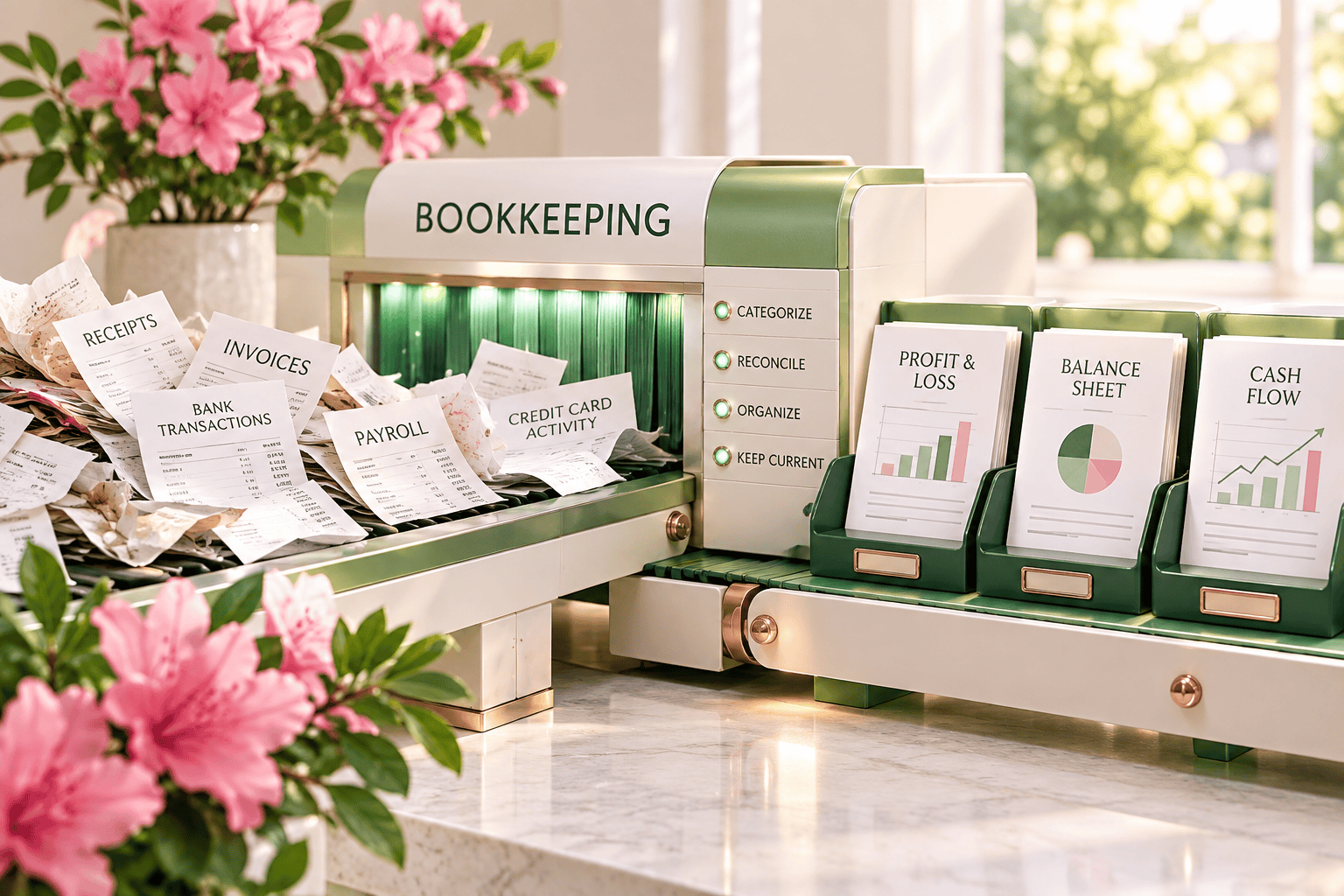
Proper bookkeeping means creating a reliable financial record of your business so that the numbers can actually be used. That generally involves categorizing transactions, reconciling accounts, reviewing balances, identifying inconsistencies and producing financial reports that make sense.
Your Books Should Tell You What Your Business Is Doing
A bank balance can tell you how much cash is in the account today. Proper books should tell you whether the business is profitable, where money is being spent, what obligations remain unpaid and how the company is performing over time.
At Azalea City Tax & Accounting, bookkeeping is part of our broader accounting and business support services , allowing the books, tax return, payroll and planning work to stay connected rather than operating in separate silos.
8 Signs You May Need Professional Bookkeeping
There is no magic revenue number at which a company suddenly requires a bookkeeper. A better test is whether the business has become difficult to understand, maintain or manage with your current system.
Your Books Are Always Behind
If transactions are routinely several weeks or months behind, your accounting system is no longer giving you current financial information.
You Dread Tax Season
If preparing for taxes means reconstructing an entire year of activity, bookkeeping has become a tax-season cleanup project instead of an ongoing financial system.
You Cannot Explain Your Profit
Revenue may be growing while the bank balance never seems to increase. Reliable books help identify whether payroll, materials, debt, overhead or other expenses are absorbing the company's cash.
Accounts Are Not Reconciled
Accounting software can contain duplicate, missing or incorrectly categorized transactions. Reconciliation is what helps verify that the books actually agree with the underlying accounts.
Business and Personal Spending Are Mixed
Heavy commingling makes bookkeeping harder, complicates tax preparation and can make it difficult to understand what the company truly costs to operate.
Payroll Has Become Complicated
Employees, payroll taxes, owner compensation and benefit-related transactions add another level of accounting and compliance complexity.
You Need Financing
Banks, lenders, landlords and investors may request current profit-and-loss statements, balance sheets or other financial information. Waiting until then to repair the books can slow the process considerably.
Bookkeeping Is Taking You Away From the Business
Even if you can do the work yourself, spending hours every week maintaining the books may no longer be the highest-value use of the owner's time.
What Are the Benefits of Professional Bookkeeping?
Outsourcing bookkeeping does not automatically improve a business. The value comes from having accurate information produced consistently enough that the owner and tax professionals can actually use it.
Greater Accuracy
Consistent categorization and reconciliation help identify duplicates, missing transactions, misclassified expenses and unusual account balances before they become larger problems.
More Time
Outsourcing repetitive accounting work gives the owner more time to focus on customers, operations, employees, sales and business growth.
Better Tax Preparation
Clean books reduce the amount of reconstruction and correction required when the business tax return is prepared.
Better Tax Planning
Tax planning becomes much more useful when it is based on reasonably current income, expenses, payroll and balance-sheet information.
Better Financial Decisions
Current financial reports help owners evaluate hiring, pricing, expenses, equipment purchases, distributions and expansion more intelligently.
Less Financial Chaos
A defined monthly process prevents an entire year's financial administration from accumulating into one overwhelming cleanup project.
What Does a Professional Bookkeeper Actually Do Each Month?
The exact scope depends on the business, but a good monthly bookkeeping process usually follows a consistent sequence.
Record & Categorize Transactions
Income and expenses are entered or imported and assigned to the appropriate accounts so the company's financial reporting remains consistent.
Reconcile Bank & Credit Accounts
Book balances are compared against bank, credit-card and other financial statements to identify missing, duplicated or incorrect items.
Review Balance-Sheet Accounts
Loans, credit cards, payroll liabilities, owner equity, fixed assets and other balances should be reviewed for unusual or unsupported amounts.
Review the Profit & Loss
Revenue and expenses are reviewed for obvious inconsistencies and to help ensure activity is being reported in the appropriate period and category.
Produce Financial Reports
The completed books can then generate useful reports for tax planning, management, budgeting, financing and business decisions.
The Three Reports Every Business Owner Should Understand
Profit & Loss
Shows revenue, expenses and profit for a particular period. It helps answer the basic question: “Did this business actually make money?”
Balance Sheet
Shows assets, liabilities and equity at a point in time, providing a broader picture of the company's financial position.
Cash-Flow Information
Helps explain why profitability and cash in the bank are not always the same thing and where business cash is actually moving.
Why Bookkeeping and Tax Planning Should Work Together
Bookkeeping and taxes are often treated as separate activities. In reality, the quality of one affects the quality of the other.
Suppose a business owner wants to know in October whether buying equipment, increasing retirement contributions or changing estimated payments could improve the year's tax position. The answer depends heavily on knowing how much the company has actually earned.
Tax Planning Requires Real Numbers
A tax projection built on books that are six months behind is only as reliable as the information going into it. Current bookkeeping allows planning to be based on what the business is actually doing instead of rough estimates.
This is why our tax planning services work particularly well when the business also maintains accurate financial records throughout the year.
Bookkeeping, payroll, tax preparation and proactive tax strategy work best when they are treated as complementary year-round services rather than disconnected annual tasks.
Can I Just Do My Own Bookkeeping?
Absolutely. Many small businesses begin with DIY bookkeeping, and there are situations where that remains perfectly reasonable.
When the Business Is Still Simple
- Relatively few monthly transactions
- No employees or complicated payroll
- Separate business banking is already maintained
- Accounts are reconciled every month
- The owner understands basic accounting categories
- Financial reports are accurate enough to use
- Bookkeeping does not consume excessive owner time
When Complexity Starts Growing
- Hundreds of monthly transactions
- Multiple bank or credit accounts
- Employees and payroll obligations
- Multiple owners or business entities
- Inventory, loans or fixed assets
- Significant tax-planning needs
- Financing or lender reporting requirements
- Books are routinely falling behind
The question is not simply, “Can I do my own bookkeeping?” The better question is whether doing it yourself continues to make financial and operational sense.
Is Professional Bookkeeping Worth the Cost?
Professional bookkeeping is an expense, and every business should evaluate whether the service provides enough value to justify that expense.
But the analysis should include more than the monthly bookkeeping fee.
Consider the Cost of Not Having Reliable Books
- Hours of owner time spent doing administrative work
- Tax-preparation cleanup fees
- Missed or poorly documented deductions
- Decisions based on inaccurate profit information
- Late or incorrect reporting
- Difficulty obtaining financing because financial statements are unavailable
- Failure to identify declining margins or rising overhead soon enough
- Additional professional fees to repair years of inconsistent records
Professional bookkeeping can create value through improved accuracy, fewer mistakes, better financial management and better tax preparation. The value generally increases as the company's financial complexity increases.
How to Choose the Right Professional Bookkeeper
Hiring a bookkeeper means giving someone responsibility for one of the most important information systems in your business. Price matters, but it should not be the only consideration.
Look for Relevant Experience
A bookkeeper should understand how small businesses operate and ideally have experience with businesses similar to yours.
Ask About Reconciliation
Data entry alone is not enough. Ask how often bank, credit-card and balance-sheet accounts are reconciled and reviewed.
Understand the Reporting Process
Know what reports you will receive, how often you will receive them and whether someone can explain unusual changes or balances.
Ask Who Handles Your Taxes
Bookkeeping becomes more valuable when the people maintaining the books can coordinate directly with the professionals responsible for tax preparation and planning.
Evaluate Communication
Good bookkeeping requires questions. You want a provider who communicates when a transaction is unclear rather than simply guessing where it belongs.
Think Beyond the Software
QuickBooks and other accounting platforms are tools. The value comes from how accurately the system is maintained and whether the resulting information can be trusted.
What if My Books Are Already a Mess?
You do not need perfect bookkeeping records before hiring a professional bookkeeper.
In fact, many engagements begin because the books have already fallen behind.
A Cleanup Project May Include
- Catching up unrecorded transactions
- Reconciling old bank and credit-card statements
- Removing duplicate transactions
- Correcting expense classifications
- Reviewing loan and credit-card balances
- Correcting owner distributions, contributions or equity accounts
- Reviewing payroll-related balances
- Rebuilding the chart of accounts
- Creating a sustainable monthly process going forward
The Goal Is Not Just to Fix the Past
A useful cleanup engagement should leave you with a system that is easier to maintain going forward. Otherwise, the same bookkeeping problem simply returns the following year.
Why Keep Bookkeeping and Tax Services Under One Roof?
There is nothing inherently wrong with using one company for bookkeeping and another for taxes. But keeping the services integrated can eliminate a common problem: the tax professional discovering issues in the books only after the year is over.
Azalea City Tax & Accounting provides bookkeeping and payroll alongside tax preparation, proactive tax planning, IRS problem solving and business consulting.
Clean Books Make Better Tax Planning Possible
When the same team understands your books, tax return and business goals, financial questions can be addressed throughout the year instead of being discovered for the first time during tax preparation.
Explore Bookkeeping & Accounting ServicesFor businesses that want to use those financial records more proactively, our tax planning services connect current bookkeeping information with decisions about entity structure, estimated taxes, deductions, retirement planning and other year-round strategies.
If inaccurate or incomplete bookkeeping has already contributed to unfiled returns or another tax problem, we also provide IRS problem solving and representation .
So, Do You Really Need Professional Bookkeeping?
Maybe not yet.
A small business with relatively simple activity can often maintain its own books successfully. But as the company adds transactions, employees, debt, equipment, multiple accounts, tax complexity and larger financial decisions, the value of a professional bookkeeping system increases quickly.
The point at which you should outsource is not necessarily when bookkeeping becomes impossible.
It may be when bookkeeping becomes too important to remain an after-hours chore.
Reliable financial records help you prepare accurate tax returns, evaluate cash flow, understand profitability, identify problems earlier and make more informed decisions about where your company should go next.
Frequently Asked Questions About Professional Bookkeeping
How do I know when my business needs a bookkeeper?
Common signs include consistently falling behind, unreconciled accounts, difficulty understanding profitability, complicated payroll, financing needs, growing transaction volume or simply spending too much valuable owner time maintaining the books.
Can I do my own bookkeeping with QuickBooks?
Yes. Accounting software makes DIY bookkeeping practical for many small businesses. The software, however, does not automatically guarantee that transactions are properly categorized, accounts are reconciled or financial statements are accurate.
How often should bookkeeping be done?
Most active businesses benefit from maintaining their books throughout the month and completing a formal monthly reconciliation and review. Businesses with heavier transaction volume may need more frequent attention.
Is bookkeeping the same as accounting?
They overlap, but they are not identical. Bookkeeping focuses heavily on maintaining the underlying financial records. Accounting uses and interprets those records for reporting, compliance, analysis, tax and financial decision-making.
Does my tax preparer need my bookkeeping?
A business tax return generally depends heavily on the company's accounting records. Accurate bookkeeping provides the income, expenses, assets, liabilities, payroll and owner transaction information needed to prepare the return accurately.
Can a professional bookkeeper fix prior-year mistakes?
Often, yes. Cleanup work can include reconciling prior activity, correcting classifications, reviewing balance-sheet accounts and rebuilding the accounting system. The exact scope depends on the condition of the records and how far back the problems extend.
Why does bookkeeping matter for tax planning?
Tax planning depends on knowing the taxpayer's current financial position. If business income and expenses are months behind, projected taxable income may also be inaccurate. Current books allow tax-planning decisions to be based on much better information.
Should the same firm handle bookkeeping and taxes?
It is not required, but there can be significant advantages. An integrated firm can often identify bookkeeping issues before tax season and use current financial information for tax planning throughout the year.
Stop Running Your Business From a Bank Balance.
Clean, current books give you a clearer picture of what your business is earning, where the money is going and what decisions you can make next. Whether your books need monthly management or a complete cleanup, our team can help get them organized and keep them that way.