
The Hidden Tax Traps of Owning Rental Property — And How to Avoid Them
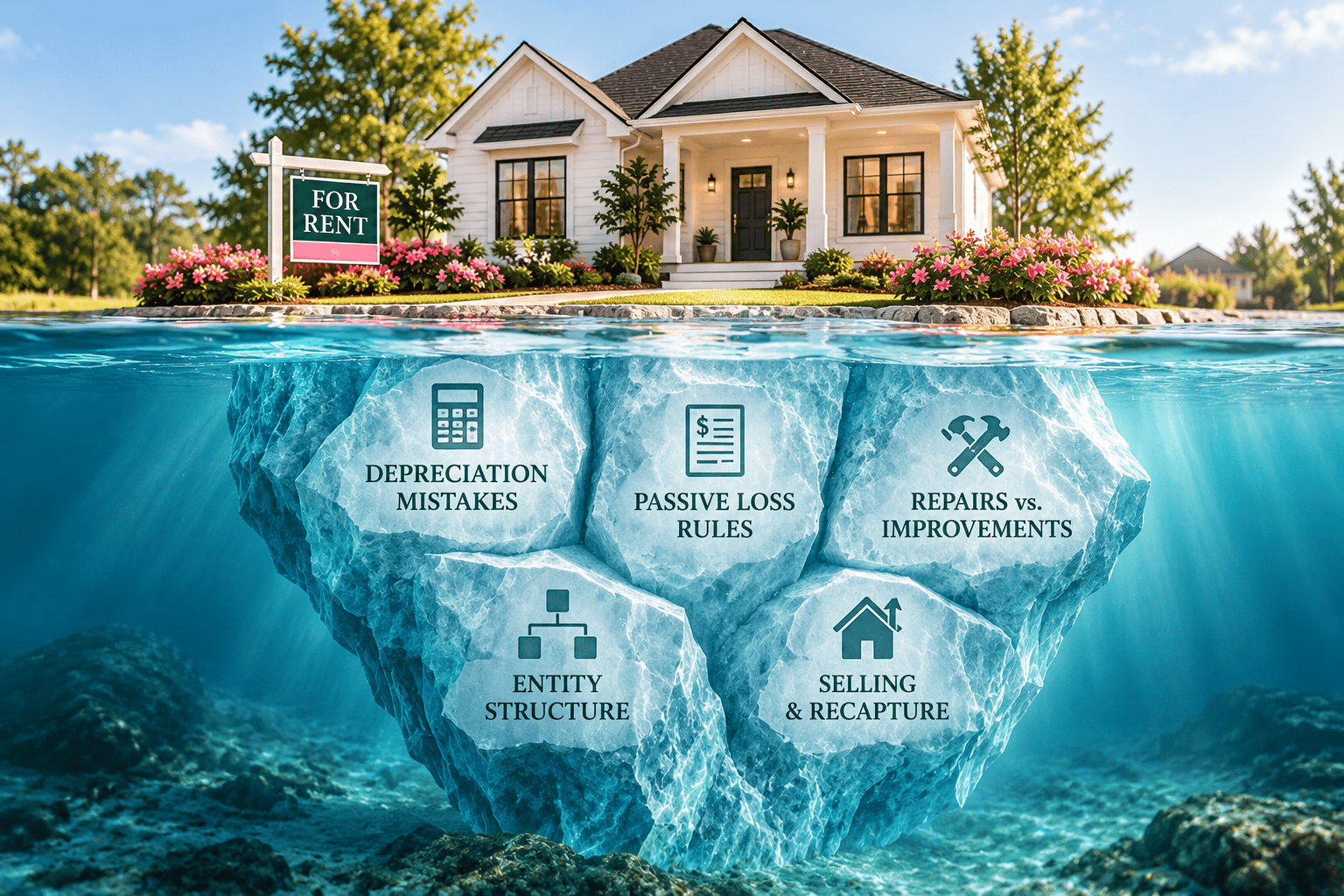
Rental property can create cash flow, appreciation, and meaningful tax advantages. But depreciation mistakes, passive-loss limitations, improper expense treatment, weak entity planning, and an unplanned sale can turn a strong investment into an expensive tax problem.
Owning rental property is often marketed as one of the best ways to build long-term wealth. Monthly cash flow, appreciation, and tax advantages all sound great on paper—and they can be. In practice, however, many rental-property owners unknowingly leave money on the table or create tax problems that could have been avoided with better planning.
At Azalea City Tax & Accounting, we regularly work with real estate investors who appear to be doing well operationally but are paying more tax than necessary, using the wrong depreciation figures, misunderstanding passive losses, or discovering a problem only when a property is sold. Rental-property taxation rewards planning, but it can punish assumptions.
The most expensive mistakes are often not dramatic. They are small decisions repeated for several years: using the wrong basis, failing to separate land from the building, deducting a capital improvement as a repair, assuming an LLC automatically changes the tax treatment, or waiting until a closing is already scheduled to begin planning for the tax consequences of a sale.
Depreciation: A Powerful Tool That Is Often Misused
Depreciation is one of the biggest tax benefits of owning rental property. In simple terms, the IRS allows the cost of a residential rental building to be recovered over time rather than requiring the owner to wait until the property is sold to recognize that investment in the property. Land itself is not depreciated.
Failing to Depreciate
Some owners simply never establish depreciation when the property enters service, leaving valuable deductions unused and creating complications later.
Using the Wrong Basis
The depreciable amount is not always the number an owner first assumes. Purchase price, acquisition costs, land allocation, improvements, and other basis adjustments can matter.
Ignoring Land Value
Land is generally not depreciable. Failing to allocate the purchase between land and the building can cause the depreciation schedule to be incorrect from the beginning.
Assuming Missed Depreciation Is Gone
Missed depreciation may require a formal correction strategy. Owners should not simply assume the deduction is permanently lost or begin changing prior treatment without reviewing the available procedure.
Not Claiming Depreciation Does Not Necessarily Avoid Recapture
One of the most frustrating traps for rental owners is assuming that skipping depreciation will make a future sale simpler. Tax rules can still take allowable depreciation into account when determining the tax consequences of a disposition, which is why depreciation should be established correctly while the property is being held.
How to Avoid the Depreciation Trap
Set up depreciation correctly when the property is placed in service and maintain a complete fixed-asset schedule. If depreciation was missed or calculated incorrectly in prior years, have the history reviewed before automatically amending returns or making a new assumption about the correct treatment.
Passive Activity Loss Rules: Why Your Losses Might Not Be Deductible
Many rental property owners are surprised to learn that rental income is generally considered passive under the tax rules. That classification can limit when losses are currently deductible, even when the rental shows a very real loss on the tax return.
There are exceptions and special rules, including the special allowance available to certain qualifying rental owners and different treatment that may apply when a taxpayer satisfies the requirements associated with real-estate-professional status and material participation. These rules are technical, and the taxpayer's actual activity matters.
How to Avoid the Passive-Loss Trap
Understand how each activity is classified before assuming a loss will be immediately available. Ownership structure, participation, grouping decisions, income levels, and the taxpayer's broader business activities can all affect the analysis. Planning is much easier before the return is prepared than after several years of suspended losses have accumulated.
Repairs vs. Improvements: A Costly Line to Cross
Rental owners spend money on their properties constantly, but not every dollar spent on a property receives the same tax treatment. A routine repair may generally be deductible currently, while an improvement may need to be capitalized and recovered over time.
| Type of Expenditure | Typical Tax Issue |
|---|---|
| Routine repair | May generally be deductible in the year paid or incurred when it does not materially improve the property. |
| Betterment | Costs that materially improve the property may need to be capitalized rather than immediately deducted. |
| Restoration | Replacing a major component or restoring property after significant deterioration can create capitalization issues. |
| Adaptation | Changing property for a new or different use can require capitalization. |
| Potential safe-harbor expenditure | Certain expenditures may qualify for favorable treatment when the applicable rules and elections are properly followed. |
Replacing a broken faucet is very different from replacing an entire plumbing system. The difficulty is that real-world projects often include both repair and improvement components, and invoices do not always separate them in a way that makes tax classification easy.
Why the Classification Matters
Deducting a major improvement as an ordinary repair can create an artificially large current deduction. If that treatment does not withstand review, the deduction can be reversed and the return may need to be recalculated. Good invoices, photographs, contracts, and descriptions of the work performed can make an enormous difference when determining the proper treatment later.
Entity Structure: One Size Does Not Fit All
Many rental owners default to a single LLC—or no entity at all—without first separating the legal-liability question from the federal tax question. An LLC can be a useful part of an asset-protection and ownership strategy, but merely forming an LLC does not automatically create a lower federal income-tax rate.
“An LLC Automatically Lowers My Taxes”
An LLC is a legal entity. Its federal tax treatment depends on ownership and any tax elections that apply. The letters “LLC” by themselves do not create a tax deduction.
“All Rentals Should Be Together”
Combining every property may simplify administration, but liability exposure, financing, ownership partners, property types, and long-term disposition plans can justify a different structure.
“Planning Can Wait”
Entity changes can become more complicated after properties appreciate, financing is in place, partners are added, or a sale is approaching.
“Tax and Liability Planning Are the Same Thing”
They overlap, but they are not identical. A good structure should be evaluated from tax, legal, financing, administrative, and long-term investment perspectives.
Entity decisions should be evaluated based on factors such as:
- The number and type of properties owned
- Whether there are multiple owners or partners
- The nature of the rental income and other business activities
- Financing and lender requirements
- Long-term asset-protection goals
- Expected exit strategy, including sale, exchange, or inheritance planning
Structure the Rental Portfolio Before the Structure Becomes the Problem
Proper structuring can improve organization, support liability planning, simplify reporting, and create a clearer foundation for long-term tax planning. The right structure depends on the investor—not on a one-size-fits-all internet formula.
Talk With Azalea CitySelling or Exchanging Property Without a Plan
Investors often spend years planning how to acquire property and almost no time planning how to dispose of it. Then a buyer appears, a contract is signed, and the investor begins asking about capital gains, depreciation recapture, and exchange strategies only days before closing.
Know the Tax Basis
Purchase basis, capital improvements, depreciation, prior exchanges, and other adjustments can affect the gain calculation. Reconstructing years of records at closing is rarely ideal.
Review the Tax Consequences Before Signing
Understanding the projected gain, recapture exposure, and state-tax implications before the transaction is committed gives the investor more useful information for decision-making.
Consider the Available Exit Strategies
Depending on the facts, an installment sale, qualifying exchange, or different timing strategy may deserve consideration. Each has its own rules and economic tradeoffs.
Plan Before Closing
Some planning opportunities depend on actions that must occur before or as part of the transaction. Waiting until after the sale closes can remove options that would otherwise have been available.
Options such as installment sales, qualifying 1031 exchanges, and transaction-timing strategies may reduce or defer tax in the right circumstances—but they need to be evaluated before the transaction is complete. Once the sale has closed, many planning opportunities can disappear.
The Bigger Picture: Rental Real Estate Is a Tax Strategy—If You Treat It Like One
The strongest rental-property tax results rarely come from searching for a deduction in March or April. They come from integrating acquisition, financing, depreciation, bookkeeping, maintenance, entity structure, participation, and disposition planning throughout the life of the investment.
Real estate can be an extraordinary long-term wealth-building tool. Its tax advantages are strongest when the property is treated as an investment business with accurate books, intentional planning, and a clearly documented long-term strategy.
What Should a Rental Property Tax Review Look At?
A useful review goes beyond checking whether rents and mortgage interest were entered on the return. It should examine how the entire property has been treated from acquisition through the present year.
| Area to Review | Questions to Ask |
|---|---|
| Basis & depreciation | Was the original basis established correctly? Was land separated? Are improvements properly added and depreciated? |
| Income & expenses | Are rents, reimbursements, repairs, management costs, insurance, taxes, and other expenses being consistently recorded? |
| Passive losses | Are losses currently deductible, suspended, or affected by participation and other income? |
| Entity structure | Does the ownership arrangement still fit the number of properties, liability goals, financing, partners, and long-term plan? |
| Future disposition | What happens if the property is sold, exchanged, transferred, inherited, or contributed to another entity? |
Your Rental Portfolio Deserves More Than Tax-Return Data Entry
We can review how your properties are structured, how depreciation and expenses are being reported, whether accumulated losses are being handled correctly, and where proactive planning may improve the long-term tax picture.
Request a Tax Planning ReviewFrequently Asked Questions About Rental Property Taxes
Do I have to depreciate my rental property?
Depreciation is a fundamental part of rental-property tax reporting. Choosing not to claim an allowable depreciation deduction does not necessarily eliminate the depreciation consequences when the property is later sold, so the schedule should be established correctly from the beginning.
Can a rental-property loss reduce my W-2 income?
Not automatically. Rental activities are generally subject to passive-activity rules, although exceptions and special allowances can apply depending on income, participation, and the taxpayer's circumstances.
Should every rental property be owned by an LLC?
There is no universal answer. LLCs can be useful legal entities, but ownership should be evaluated in light of liability exposure, financing, number of properties, partners, tax reporting, administrative burden, and long-term plans.
Can I deduct a new roof as a repair?
Major replacements can raise capitalization issues and should not automatically be treated the same as routine repairs. The scope of the project and the applicable improvement rules need to be evaluated.
What happens to depreciation when I sell a rental?
Depreciation affects the property's adjusted basis and can create additional tax consequences when the property is sold. That is one reason the projected tax result should be calculated before a sale closes.
When should I start planning for a 1031 exchange or other sale strategy?
Before the sale is completed—preferably before the transaction is locked in. Certain strategies have timing, documentation, and procedural requirements that cannot simply be recreated after closing.
When should a rental owner get a tax-planning review?
A review is particularly valuable when acquiring a new property, adding partners, making major improvements, changing entities, accumulating suspended losses, refinancing, or considering a sale or exchange.
Make the Tax Strategy Part of the Investment Strategy.
If you are unsure whether your rental properties are depreciated correctly, structured efficiently, carrying suspended losses, or positioned for a future sale, Azalea City Tax & Accounting can help you review the complete picture before a hidden tax issue becomes an expensive surprise.