
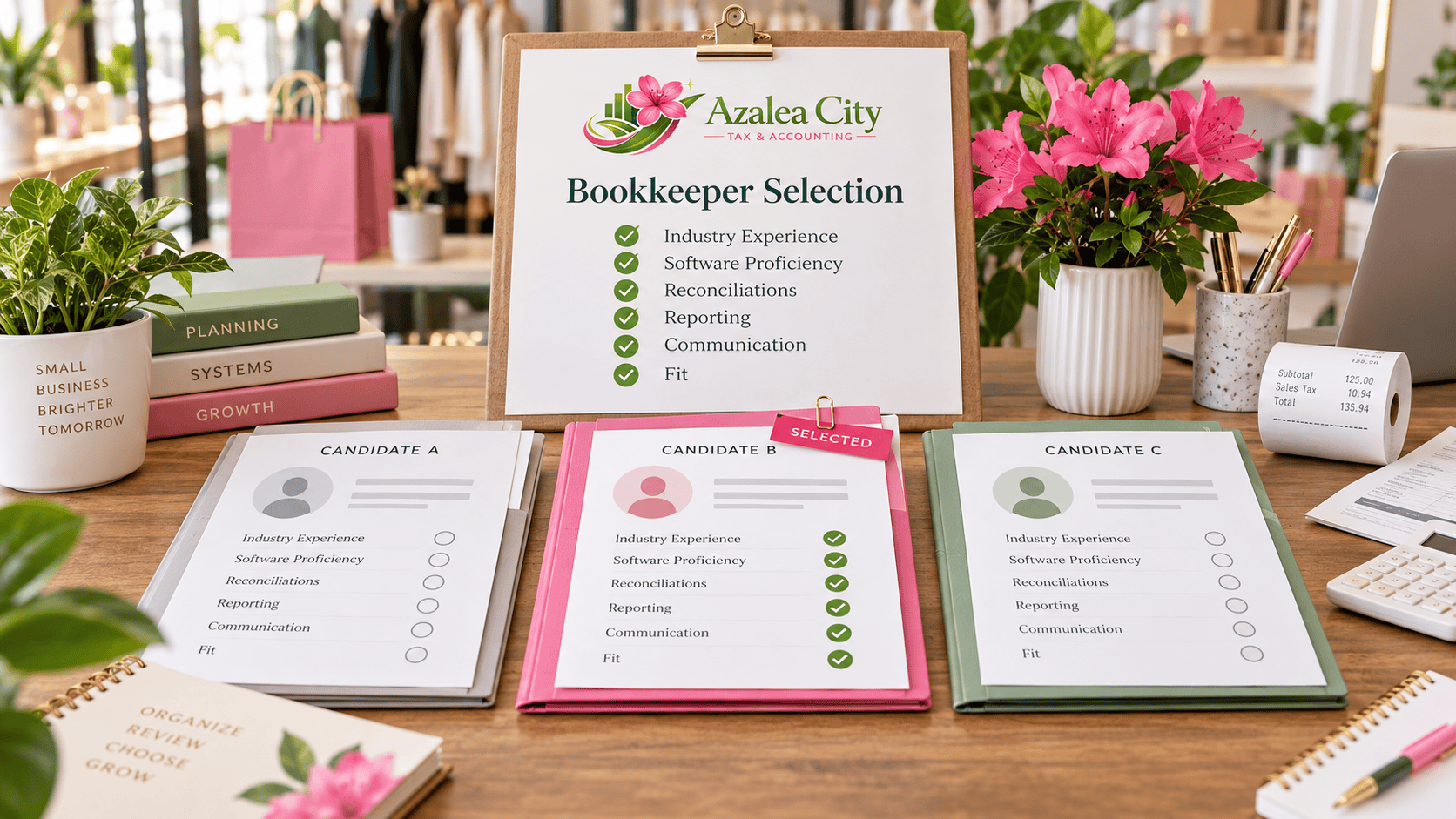
Selecting the Right Bookkeeper: How to Choose the Best Fit for Your Business
The right bookkeeper does more than enter transactions. They help create the financial foundation your business relies on for accurate reporting, tax preparation, cash-flow management, and better decisions. Here is what to look for before trusting someone with your books.
Selecting the right bookkeeper is an important decision for any business. Your books influence tax returns, financial statements, lending decisions, cash-flow planning, business valuations, and many of the decisions you make throughout the year.
That means the cheapest person who can operate accounting software is not necessarily the right choice. A strong bookkeeper should understand your business, maintain reliable records, communicate clearly, use appropriate systems, and work effectively with the professionals responsible for your accounting and taxes.
1. Start by Understanding What Your Business Actually Needs
Before comparing bookkeeping firms or individual bookkeepers, determine what you are actually hiring someone to accomplish.
Two businesses with identical revenue can have completely different bookkeeping needs. A consultant receiving a few customer payments each month may have a relatively simple set of books. A construction company with payroll, subcontractors, equipment, job costs, credit cards, loans, and dozens of monthly projects may require significantly more sophisticated bookkeeping.
Transaction Activity
Consider the number of bank transactions, credit cards, invoices, bills, payroll entries, loans, transfers, and other transactions occurring each month.
Business Structure
Multiple entities, locations, departments, inventory, job costing, payroll, financing, or complicated owner activity may require a higher level of bookkeeping expertise.
Information You Need
Decide whether you simply need compliant records or whether management needs monthly reports, cash-flow information, budgets, job profitability, or other financial analysis.
Questions to Ask Yourself
- How many accounts and credit cards need to be reconciled?
- Do we have employees or payroll?
- Do we invoice customers or track accounts receivable?
- Do we need bill payment or accounts payable support?
- Do we have loans, equipment, or fixed assets?
- Do we need job, department, location, or project tracking?
- How frequently do we need financial reports?
- Who will coordinate the books with our tax professional?
2. Look for Relevant Bookkeeping Experience
There is no substitute for experience. Someone who has worked with real businesses and dealt with messy bank reconciliations, owner transactions, payroll problems, loans, credit cards, bookkeeping cleanups, and year-end adjustments will generally recognize problems more quickly than someone who only knows the mechanics of entering transactions.
Years of experience are important, but relevant experience matters even more.
Ask whether the bookkeeper routinely works with businesses similar to yours in size, transaction volume, and complexity.
Ask about the books they actually manage.
Instead of simply asking, “How long have you been a bookkeeper?” ask about the types of businesses they currently serve, the complexity of those accounts, and the financial problems they regularly solve.
3. Consider Experience in Your Industry
A bookkeeper does not necessarily need to specialize exclusively in your industry, but familiarity with your business model can be extremely valuable.
Different industries create different accounting challenges. Contractors may need job costing and subcontractor tracking. Property-management companies may deal with owner funds and property-level reporting. Retail businesses may have inventory and merchant-processing activity. Professional firms may focus heavily on receivables, payroll, and profitability.
| Business Type | Bookkeeping Issues That May Matter |
|---|---|
| Construction & Trades | Job costing, subcontractors, equipment, deposits, progress billing, payroll, and project profitability. |
| Professional Services | Accounts receivable, payroll, owner compensation, overhead, utilization, and service profitability. |
| Retail & E-Commerce | Inventory, merchant processors, sales tax, returns, platform deposits, and cost of goods sold. |
| Real Estate & Property Management | Property-level reporting, owner activity, security deposits, management income, repairs, and potentially separate trust or operating activity. |
| Restaurants & Hospitality | High transaction volume, payroll, tips, merchant fees, food costs, inventory, and tight margin monitoring. |
4. Understand Qualifications and Credentials
Bookkeeping itself is generally not a licensed profession. Someone can provide bookkeeping services without holding a CPA license or another government-issued professional credential.
That makes your evaluation of education, training, experience, supervision, internal procedures, and professional reputation especially important.
Bookkeeping certifications and accounting education can demonstrate additional training, but credentials should be evaluated together with practical experience and the quality of the firm's processes.
A credential is useful—but it is not the entire evaluation.
A strong bookkeeper needs technical knowledge, practical judgment, organizational discipline, communication skills, and a reliable system for reviewing the work. Look at the whole picture.
5. Evaluate Their Technology and Accounting Software
Modern bookkeeping is heavily technology-driven. Your bookkeeper should be comfortable not only with accounting software but also with the systems surrounding it.
Depending on your business, that may include bank feeds, payroll platforms, merchant processors, receipt-management software, invoicing systems, point-of-sale systems, accounts-payable tools, and cloud document storage.
Technology Questions Worth Asking
- Which accounting platforms do you regularly use?
- How are bank and credit-card accounts reconciled?
- How do clients submit receipts and documents?
- How do you handle payroll information?
- How is access to financial information protected?
- Who has access to my books and financial accounts?
- How frequently are the books updated?
- Can I access my financial reports when I need them?
Technology should make your bookkeeping process easier, more accurate, and more transparent—not turn it into a collection of disconnected applications you do not understand.
6. Pay Close Attention to Communication
A bookkeeper can be technically competent and still be a poor fit if communication is inconsistent.
Your books frequently require information only you can provide. A good bookkeeper should have an organized process for identifying missing information, asking questions, resolving unusual transactions, and keeping you informed.
Questions Get Answered
You should understand how to contact your bookkeeping team and have reasonable expectations for when questions will be addressed.
Financials Make Sense
Your bookkeeper should be able to explain issues without burying you in accounting terminology you cannot use.
Problems Are Identified
Strong bookkeeping means bringing unexplained balances, unusual activity, and missing information to your attention instead of letting problems accumulate.
7. Ask What Their Monthly Bookkeeping Process Actually Includes
One of the biggest mistakes business owners make is assuming that all bookkeeping services include the same work. They do not.
Two firms may both advertise “monthly bookkeeping” while delivering dramatically different levels of service.
Transactions are categorized.
Income, expenses, transfers, loan activity, and other transactions are assigned to appropriate accounts.
Accounts are reconciled.
Bank and credit-card balances should be compared with underlying statements so discrepancies can be identified.
Unusual transactions are reviewed.
Loans, owner payments, transfers, payroll, equipment purchases, and other transactions may require more than automatic categorization.
Financial reports are produced.
The completed books should provide useful financial statements that management and tax professionals can rely upon.
Bank-feed categorization alone is not full bookkeeping.
Accounting software can suggest transaction categories, but software does not replace proper reconciliation, review, financial judgment, or verification that the resulting financial statements actually make sense.
8. Compare Cost Based on Value—not Price Alone
Price matters. Every business has a budget. But bookkeeping is one area where an inexpensive service can become very expensive if poor work eventually has to be corrected.
Before comparing prices, make sure you are comparing the same scope of work.
Find Out Exactly What the Fee Includes
- Number of bank and credit-card accounts
- Monthly transaction volume
- Bank and credit-card reconciliations
- Accounts payable or bill-payment services
- Accounts receivable or invoicing support
- Payroll processing or payroll reconciliation
- Monthly financial statements
- Bookkeeping cleanup work
- Year-end accounting coordination
- Tax-return coordination
- Management meetings or advisory support
A higher monthly fee may actually represent better value if it includes reconciliation, review, financial reporting, professional oversight, and coordination with your tax return.
9. Make Sure the Relationship Is a Good Fit
A bookkeeping relationship often lasts for years. The provider will see sensitive financial information and may interact with owners, management, accountants, payroll providers, and tax professionals.
You need someone whose working style is compatible with yours.
Pay attention to professionalism from the beginning. Do they appear organized? Are expectations clearly explained? Are documents requested systematically? Are deadlines communicated? Do they ask thoughtful questions about your company?
Those early interactions often provide a good indication of what the ongoing relationship will look like.
10. Check Reputation, References, and Recommendations
Reputation matters when you are giving someone access to sensitive financial records.
Recommendations from business owners, accountants, attorneys, bankers, or other trusted professionals can be useful. Online reviews may also help you identify patterns in how a firm treats its clients.
When appropriate, ask whether the provider can explain the kinds of clients they typically work with or provide references consistent with professional confidentiality requirements.
Look for Patterns—not One Isolated Review
A useful reputation check looks beyond a single positive or negative comment. Look for consistent feedback about communication, accuracy, reliability, professionalism, and responsiveness.
11. Continue Evaluating the Bookkeeping After You Hire Someone
Choosing a bookkeeper is not the end of the process. Business owners should continue evaluating whether the financial records are accurate, timely, and useful.
Your business may also outgrow the level of service that was appropriate when the relationship began.
| Review Question | What You Want to See |
|---|---|
| Are the books current? | Transactions and reconciliations are completed on a predictable schedule. |
| Are bank accounts reconciled? | Book balances agree with underlying statements and unexplained differences are investigated. |
| Do the reports make sense? | Financial statements are consistent with what is actually happening in the business. |
| Are questions addressed? | Missing documents and unusual transactions are resolved instead of accumulating. |
| Is tax season smooth? | Records can be provided to the tax professional without a major year-end cleanup project. |
Red Flags to Watch for When Hiring a Bookkeeper
Sometimes the easiest way to identify the right bookkeeper is to recognize the wrong one.
- They cannot clearly explain what their monthly service includes.
- They rely almost entirely on automated bank-feed rules without meaningful account reconciliation or review.
- Financial statements are consistently delivered late.
- They rarely ask questions about unusual transactions.
- Large balances remain in categories such as “uncategorized,” “ask my accountant,” or miscellaneous accounts for extended periods.
- They do not understand how loans, credit cards, payroll, owner draws, contributions, or transfers should be treated.
- They cannot explain the balance sheet.
- They discourage your accountant or tax professional from reviewing the books.
- You regularly discover errors only when the tax return is being prepared.
- You do not know when the books were last reconciled.
Your financial statements should not be a mystery.
A business owner does not need to become an accountant, but you should be able to ask reasonable questions about your Profit & Loss, Balance Sheet, and cash position—and receive an understandable answer.
One Major Advantage: Bookkeeping That Connects With Your Taxes
Bookkeeping should not exist in isolation from accounting and tax preparation.
The books ultimately become the foundation for many of the numbers reported on a business tax return. When the bookkeeping team and tax team communicate throughout the year, problems can often be identified before tax season.
That integration can also help identify issues involving fixed assets, loans, shareholder or partner activity, payroll, estimated taxes, entity structure, and other matters that affect both financial reporting and taxation.
Bookkeeping Should Support the Entire Business
Our bookkeeping services are designed to work alongside accounting, payroll, tax preparation, tax planning, and business consulting. Instead of treating your books as an isolated data-entry project, we help build financial records that can actually support your business decisions.
Explore Bookkeeping & Payroll ServicesThe Right Bookkeeper Becomes Part of Your Financial Foundation
Selecting a bookkeeper should not simply be a search for someone willing to enter transactions at the lowest monthly price.
Look for someone who understands your business, maintains accurate records, reconciles accounts properly, communicates consistently, uses technology effectively, understands your industry when necessary, and can coordinate the books with the accounting and tax work that comes next.
Most importantly, your bookkeeping should give you confidence in the numbers. Good books should help you understand your business—not leave you wondering what happened to the money.
Frequently Asked Questions
What should I look for when hiring a bookkeeper?
Look at relevant experience, knowledge of your industry, bookkeeping processes, software proficiency, communication, references, security practices, reporting procedures, and how the bookkeeper coordinates with your accountant or tax professional. Price should be considered together with the actual scope and quality of the service.
Does a bookkeeper need to be a CPA?
No. Routine bookkeeping generally does not require someone to hold a CPA license. However, education, experience, professional certifications, internal quality controls, and supervision can all be relevant when selecting a provider.
How often should my books be updated?
Many small businesses use a monthly bookkeeping cycle, although higher-volume or more complex businesses may need weekly or more frequent activity. At a minimum, financial records should be current enough to provide useful information for management, tax planning, and financial decisions.
Should my bookkeeper reconcile every bank and credit-card account?
Reconciliation is a fundamental bookkeeping control. Accounts appearing on the books should generally be reconciled to reliable underlying records so missing, duplicated, or incorrectly recorded transactions can be identified.
Is QuickBooks enough to manage my bookkeeping automatically?
Accounting software is a powerful tool, but it does not replace human review. Automated categorization can help process transactions, but reconciliation, unusual transactions, accounting treatment, financial-statement review, and many business-specific issues still require judgment.
Should my bookkeeper and tax preparer communicate?
Yes. Coordination between bookkeeping and tax professionals can help reduce year-end cleanup, identify accounting issues earlier, improve tax return preparation, and make proactive tax planning easier.
How do I know whether my current bookkeeper is doing a good job?
Your accounts should be reconciled, reports should be produced consistently, unusual transactions should be investigated, questions should be addressed, and the financial statements should reasonably reflect what is happening in your business. Tax season should also not require repeatedly rebuilding the books from scratch.
Your Books Should Tell You How Your Business Is Really Doing.
Azalea City Tax & Accounting provides professional bookkeeping, payroll, accounting, tax preparation, and business advisory services designed to work together—so you have cleaner records, better information, and fewer surprises.