
How Is an LLC Taxed?
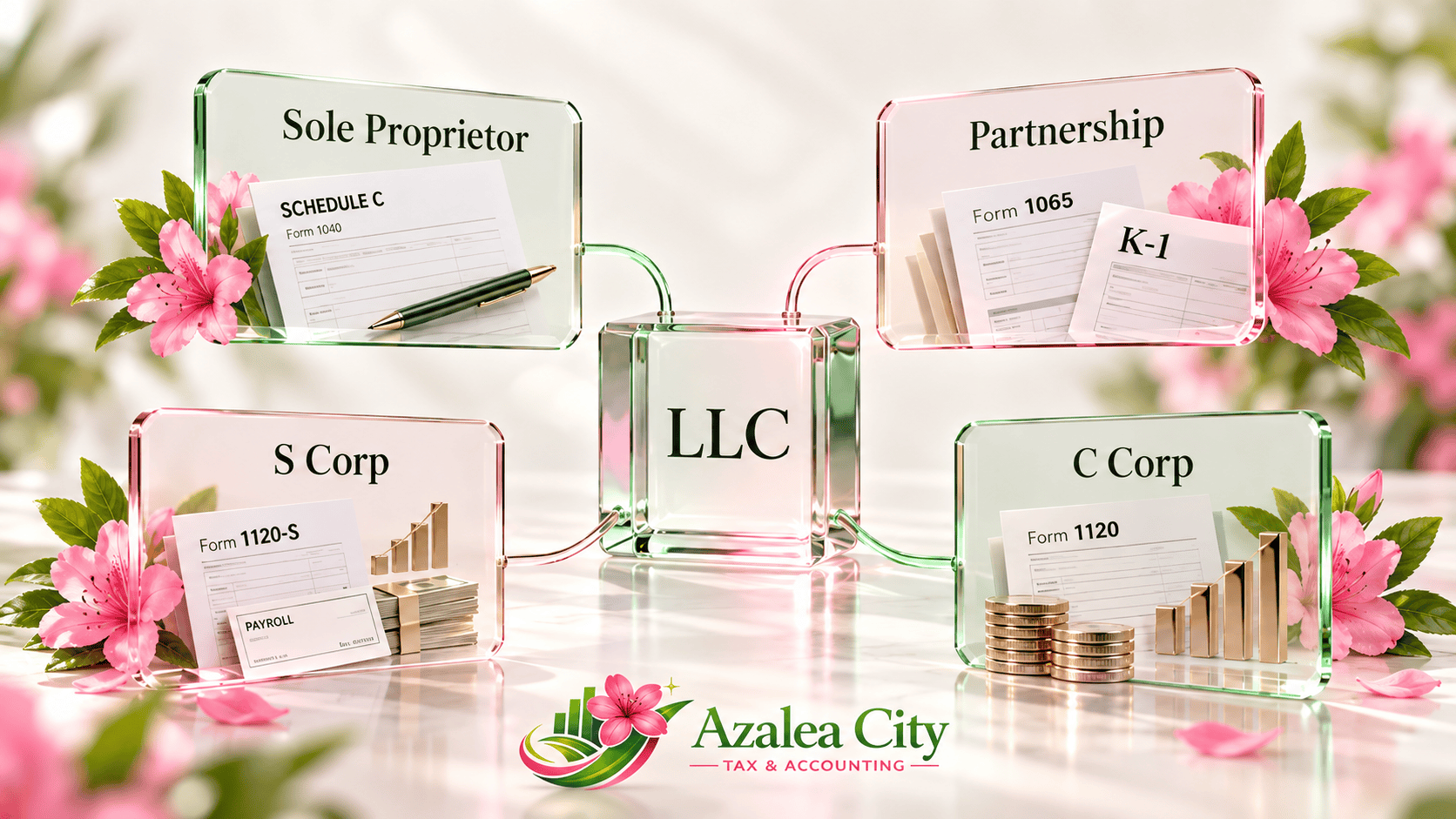
An LLC does not have one single federal tax treatment. Depending on the number of owners and elections made with the IRS, an LLC may be taxed as a disregarded entity, partnership, S corporation or C corporation. Understanding the difference can have a major impact on how your business reports income, pays taxes and compensates its owners.
One of the most common misconceptions among new business owners is that forming an LLC automatically tells the IRS how the business will be taxed.
It does not. LLC describes a legal business structure created under state law. Federal tax classification is a separate question. Depending on the number of members and elections made by the business, the same LLC may be treated very differently for federal income tax purposes.
An LLC Is a Legal Structure, Not a Federal Tax Classification
A Limited Liability Company, commonly called an LLC, is a business entity organized under state law. One of its most attractive features is flexibility.
For federal income tax purposes, the IRS looks at factors such as the number of owners and any tax elections the LLC has made.
“LLC” Does Not Mean “Taxed One Particular Way”
An LLC can remain an LLC under state law while being treated as a disregarded entity, partnership, S corporation or C corporation for federal income tax purposes.
The IRS provides its own overview of Limited Liability Company tax classifications .
The Four Main Ways an LLC Can Be Taxed
For most domestic LLCs, federal income tax treatment falls into one of four general categories.
| LLC Tax Treatment | Typical Federal Return | General Tax Character |
|---|---|---|
| Single-Member Disregarded Entity | Commonly Schedule C, E or F with the owner's return depending on the activity | Activity generally reported directly by the owner |
| Partnership | Form 1065 and Schedule K-1 | Generally pass-through taxation |
| S Corporation | Form 1120-S and Schedule K-1 | Generally pass-through taxation with special compensation and payroll considerations |
| C Corporation | Form 1120 | Corporation generally pays federal income tax at the entity level |
How Is a Single-Member LLC Taxed?
If a domestic LLC has only one member and does not make a corporate tax election, the IRS generally treats it as a disregarded entity for federal income tax purposes.
“Disregarded” does not mean the LLC does not exist legally. It means that, for federal income tax purposes, the business activity is generally reported through its owner rather than on a separate federal income tax return for the LLC.
Where Does the Income Get Reported?
The answer depends on what the LLC does.
- An active business owned by an individual commonly uses Schedule C.
- Rental real estate activity may be reported on Schedule E.
- Farming activity may be reported on Schedule F.
Legal Separation and Tax Reporting Are Different Questions
The LLC can still exist as a separate legal entity under state law even when the IRS disregards it as separate from its owner for federal income tax purposes.
What About Self-Employment Tax?
When an individual owns a single-member LLC operating an active trade or business, net business earnings are commonly subject to self-employment tax in addition to income tax, subject to the applicable federal rules.
How Is a Multi-Member LLC Taxed?
A domestic LLC with two or more members is generally taxed as a partnership by default unless the business elects corporate classification.
A partnership generally does not work like a traditional C corporation in which the entity itself pays federal income tax on all of its ordinary taxable profit.
Instead, the partnership generally files an informational return on Form 1065, and the members receive Schedules K-1 showing their respective shares of taxable items.
Partnership Taxation Can Be Flexible
- Pass-through federal income tax treatment
- Potential flexibility in economic arrangements, subject to partnership tax rules
- No separate federal corporate income tax on ordinary partnership income
- Useful structure for many multi-owner businesses and investment arrangements
Partnership Tax Can Become Complex
- Basis calculations
- Capital-account tracking
- Guaranteed payments
- Self-employment tax considerations
- Special allocations and distribution rules
- Multi-state filing issues
The IRS provides additional information about LLCs filing as partnerships or corporations .
How Does an LLC Elect S Corporation Taxation?
An LLC does not need to convert into a corporation under state law simply to obtain S corporation tax treatment. An eligible LLC can make an S corporation election for federal tax purposes while continuing to operate legally as an LLC.
An eligible entity generally makes the S corporation election using Form 2553, Election by a Small Business Corporation.
The IRS provides current guidance and forms on its Form 2553 information page .
Why Do Business Owners Consider S Corporation Taxation?
One of the most frequently discussed reasons involves the treatment of compensation and business profit.
A shareholder who performs services for an S corporation generally must receive appropriate wages for those services. Those wages are subject to payroll-tax rules. Additional pass-through business income may be treated differently for employment-tax purposes.
S Corporation Does Not Mean “No Payroll Taxes”
An owner cannot simply label all business profit a distribution while taking no reasonable compensation for substantial services performed for the company. Owner compensation should be planned and documented appropriately.
Potential Benefits
- Pass-through federal income tax treatment
- Potential employment-tax planning opportunities when properly structured
- Clear separation between wages and shareholder distributions
- Can work well for certain profitable owner-operated businesses
Potential Drawbacks
- Payroll becomes important
- Reasonable compensation must be considered
- A separate Form 1120-S is generally required
- Eligibility requirements must be maintained
- S corporation distribution and ownership rules are less flexible than partnership taxation
- Additional accounting and compliance costs may offset part of the tax benefit
An S Corporation Election Should Be Calculated, Not Guessed
Whether S corporation taxation makes sense depends on business profit, reasonable compensation, payroll costs, state taxes, retirement planning, administrative expense and the owner's broader tax situation.
Explore Tax PlanningHow Does an LLC Elect C Corporation Taxation?
An eligible LLC can elect to be classified as a corporation for federal income tax purposes using Form 8832, Entity Classification Election.
Once treated as a C corporation, the entity generally files Form 1120 and is responsible for federal corporate income tax on its taxable income.
The IRS maintains current information regarding Form 8832 and entity classification elections .
Why C Corporation Treatment May Be Considered
- Separate entity-level income taxation
- Potential advantages for businesses retaining substantial earnings for growth
- Certain employee-benefit planning opportunities
- May fit particular investment, ownership or long-term business strategies
Why C Corporation Treatment Requires Careful Analysis
- Corporate income may be taxed at the entity level
- Distributions treated as dividends can create a second level of federal income tax
- Changing tax classification later can have tax consequences
- State taxation can materially affect the analysis
- The structure may be less attractive when owners expect to regularly distribute most profits
What Does “Pass-Through Taxation” Actually Mean?
Single-member disregarded LLCs, partnerships and S corporations are commonly discussed as pass-through structures, although the mechanics differ between them.
The basic idea is that taxable business income is generally reported by the owner or owners rather than being subject to the ordinary federal C corporation income-tax system.
“Pass-Through” Does Not Mean “Tax-Free”
Business income may still create federal income tax, self-employment tax, payroll tax, state tax or other tax obligations. Pass-through describes how taxable items move through the entity structure; it does not eliminate the underlying tax.
Another important issue is that pass-through owners may owe tax on their allocated or reported taxable income even when the same amount of cash was not distributed to them. Distribution planning and estimated-tax planning therefore matter.
How Do You Choose the Right Tax Treatment for an LLC?
There is no universal rule that every profitable LLC should elect S corporation taxation or that every growing company should become a C corporation.
The right choice depends on the economics of the particular business and its owners.
Estimate Sustainable Business Profit
Tax elections should be evaluated using realistic recurring profit, not simply gross revenue or one unusually strong month.
Evaluate Owner Compensation
If S corporation taxation is being considered, determine what reasonable compensation for the owner's services is likely to look like before estimating potential payroll-tax savings.
Consider How Profits Will Be Used
A company distributing nearly all available profit to owners may have different priorities from a company planning to retain substantial capital for expansion.
Include State Taxes
Federal tax savings should not be analyzed in isolation. State income taxes, franchise taxes, entity-level taxes and filing requirements can materially change the result.
Price the Administrative Cost
Payroll, additional tax returns, bookkeeping, tax preparation and compliance all have costs. The expected tax benefit should be compared against those ongoing expenses.
Consider the Long-Term Plan
Ownership changes, investors, asset purchases, retirement planning, real estate, succession and a potential future sale can all influence which tax classification makes sense.
Common LLC Tax Misconceptions
“I Formed an LLC, So I Am Automatically an S Corporation.”
No. An LLC does not become an S corporation merely because it was formed with the state. S corporation taxation generally requires a valid federal election and continued eligibility.
“An LLC Means I Pay Less Tax.”
Not automatically. Forming an LLC does not by itself reduce taxable income or guarantee a lower tax bill. The result depends on the LLC's tax classification, business profit, deductions and the owner's overall tax circumstances.
“S Corporation Distributions Are Completely Tax-Free.”
Generally, S corporation income passes through to shareholders for income-tax purposes. The fact that a distribution may not be subject to payroll tax in the same manner as wages does not mean the underlying business income disappears from federal income taxation.
“If I Leave the Money in the LLC, I Do Not Owe Tax on It.”
That can be incorrect for pass-through structures. Owners can have taxable income even when the business retains cash instead of distributing all of it.
“Once I Pick a Tax Classification, It Never Matters Again.”
Businesses change. Profit, ownership, compensation, investments and long-term plans can all change the tax analysis. Tax classification should be reviewed periodically rather than treated as a permanent decision that never deserves another look.
When Should You Review Your LLC's Tax Classification?
The tax treatment that worked when the business was new may not remain the best choice after several years of growth.
Consider a Review When:
- Business profit has increased significantly.
- You are beginning to hire employees.
- You are considering an S corporation election.
- You are adding or removing owners.
- The business is expanding into additional states.
- You expect to retain substantial profits for expansion.
- You are making large equipment or real-estate investments.
- Retirement-plan contributions are becoming a significant planning objective.
- You are preparing to sell, transfer or restructure the business.
Entity Structure Should Evolve With the Business
At Azalea City Tax & Accounting, we look beyond simply filing the return. Business owners can review entity structure, owner compensation, bookkeeping, retirement planning, estimated taxes and other planning opportunities before year-end.
Schedule a Tax ConsultationThe Bottom Line: How Is an LLC Taxed?
The most accurate answer is: it depends on the LLC's tax classification.
A single-member LLC is generally disregarded for federal income tax purposes unless it makes an election. A multi-member LLC is generally taxed as a partnership unless it makes an election. Eligible LLCs can also elect S corporation or C corporation tax treatment.
Each approach changes how income is reported, how owners may be compensated, which tax returns must be filed and what administrative responsibilities the business takes on.
The objective should not be to choose the tax structure that sounds the most sophisticated. It should be to choose the structure that makes sense for the company's actual profit, ownership, cash flow, growth plans and long-term goals.
That is why entity selection and tax classification are best treated as planning decisions rather than paperwork decisions.
Frequently Asked Questions About LLC Taxes
Does an LLC automatically pay its own federal income tax?
Not necessarily. A single-member LLC is generally disregarded for federal income tax purposes by default, while a multi-member LLC is generally taxed as a partnership by default. An LLC can also elect corporate tax treatment when eligible.
How is a one-owner LLC taxed?
A domestic single-member LLC is generally treated as a disregarded entity for federal income tax purposes unless it elects to be taxed as a corporation. The specific tax schedule used depends on the type of activity conducted by the LLC.
How is an LLC with two or more owners taxed?
A domestic LLC with two or more members is generally classified as a partnership for federal income tax purposes unless it elects corporate treatment. Partnership-taxed LLCs generally file Form 1065 and issue Schedules K-1 to members.
Can an LLC be taxed as an S corporation?
Yes, if the LLC is eligible and makes the appropriate federal election. The business can remain legally organized as an LLC while being treated as an S corporation for federal tax purposes.
Does an LLC need to file Form 8832 to become an S corporation?
An eligible entity can generally make an S corporation election using Form 2553. Under IRS entity-classification rules, a timely and valid S corporation election can also provide the necessary corporate classification without a separate Form 8832 in many situations. Specific facts and filing history should still be reviewed.
Are LLC distributions tax-free?
That is too broad a statement. The tax treatment of distributions depends on whether the LLC is taxed as a disregarded entity, partnership, S corporation or C corporation, along with basis and other applicable tax rules.
Does forming an LLC automatically reduce self-employment tax?
No. Simply forming an LLC does not automatically reduce self-employment tax. Federal tax treatment depends on the LLC's classification and the nature of the owner's income and activities.
When does S corporation taxation start making sense?
There is no universal profit number. A proper analysis should compare expected business profit, reasonable owner compensation, payroll costs, state taxes, bookkeeping and return-preparation costs, retirement-plan considerations and the owner's total tax situation.
Can an LLC change how it is taxed later?
In many circumstances an eligible LLC can change its federal tax classification or make a different election. However, timing limitations, tax consequences and election rules may apply, so the change should be reviewed before filing it.
Are LLC tax rules the same in every state?
No. Federal classification rules do not eliminate state-specific taxes, fees, annual reports, franchise taxes or other state requirements. State treatment should be reviewed separately.
Your LLC Structure Is Only Half the Question.
The way your LLC is taxed can affect owner compensation, payroll taxes, business returns, distributions and your overall tax strategy. If you are starting a business, considering an S corporation election or wondering whether your current structure still makes sense, our team can help you evaluate the numbers.